A Brief History of the Dumfries and Galloway Angling Association
The Dumfries and Galloway Angling Association (DGAA) has a proud and enduring legacy that stretches back to 1885, when it was originally founded as the Dumfries and Maxwelltown Angling Association.
Established during a time when angling was gaining popularity as both a sport and social pastime, the Association was formed with a clear and noble purpose with its very first rule setting the tone for generations to come:
“1st – To encourage legal angling in this district, and to raise this healthy pastime to an honourable position, so that every gentleman will consider it to his advantage to be a member of the association.”
This founding principle reflected a commitment to lawful and ethical fishing practices, as well as a desire to elevate angling as a respected and civil pursuit within the local community.
Initially, the Association focused primarily on the promotion of trout fishing (‘white fish’), an emphasis which largely continued until the Fishery Board (amongst others) created the Nith Fishings Improvement Association in 1934. This new body helped address significant pollution issues and long-standing neglect of the river leading to a gradual improvement in migratory fish populations — from a low of just 12 salmon reported across the entire River Nith in 1921.
Key Figures
John Cunningham
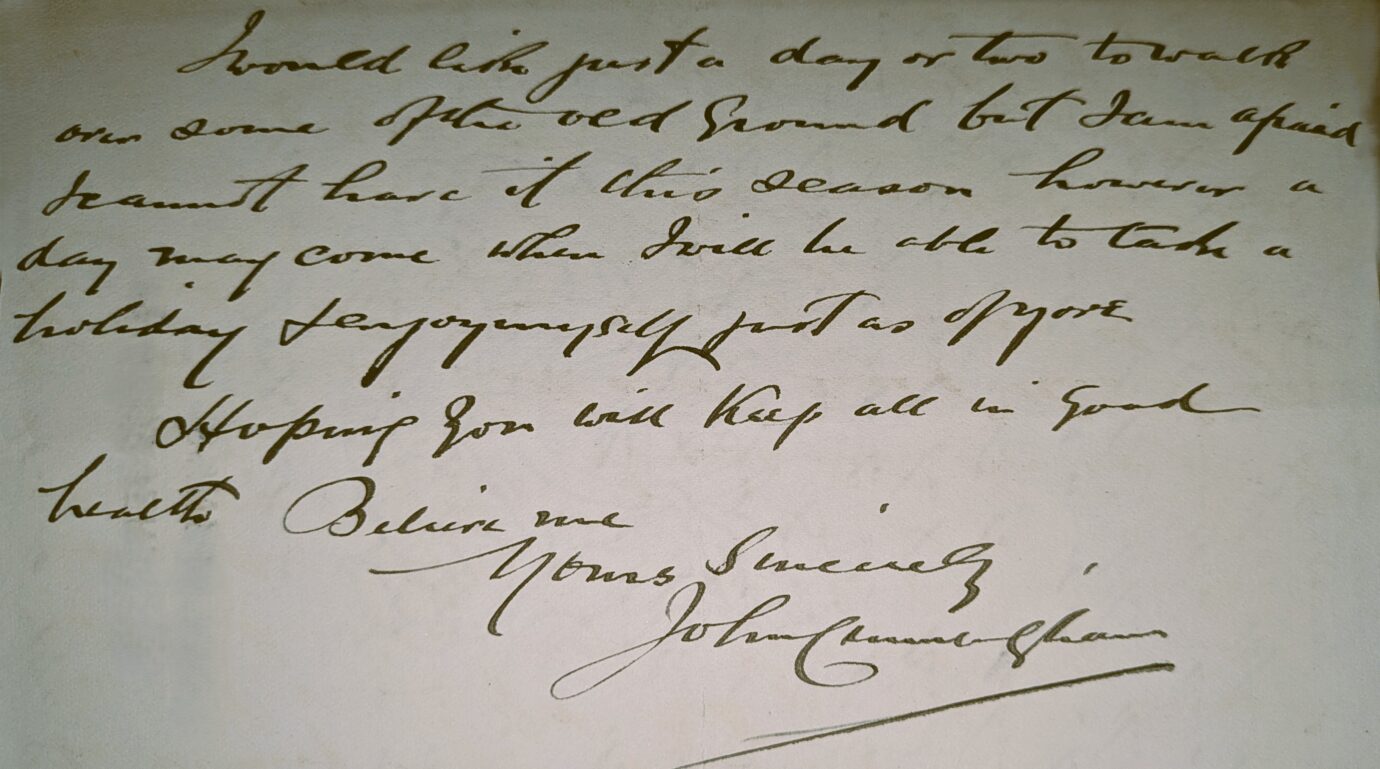
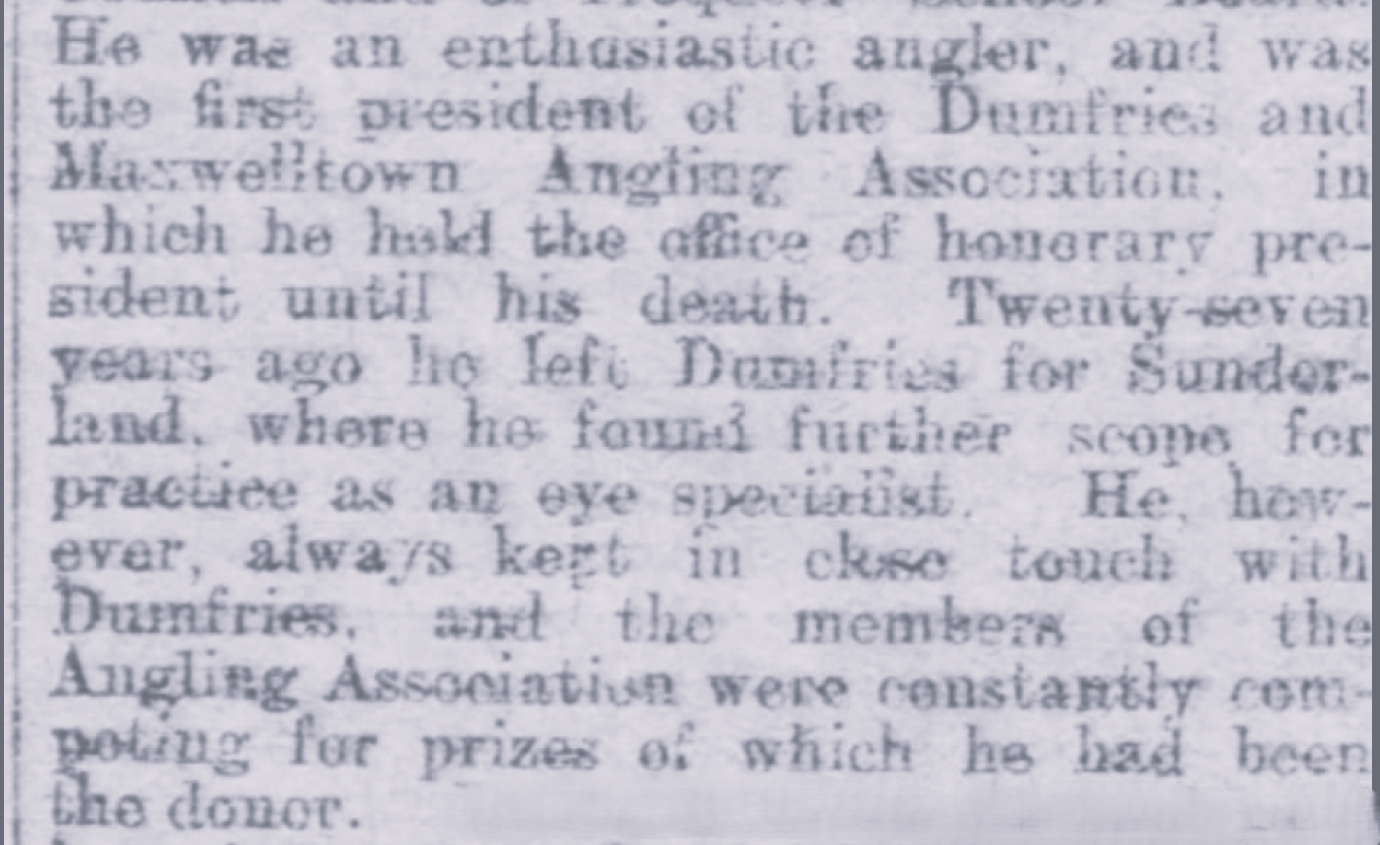
As the Association took shape, its early success was driven by influential figures whose dedication laid the foundation for its creation and enduring legacy. One such individual was Dr John Cunningham, who served as president from the Association’s inception in 1885 and, according to contemporary newspaper reports, was entirely instrumental in its formation. Such was the high regard in which ‘Dr John’ was held in both Dumfries and within the Association that even when his medical career took him to Sunderland at the end of 1890, he remained honorary president until his death in 1918.
David McMillan
The name McMillan has echoed through the Association’s history since its inception. David McMillan was hugely influential in founding the Association, serving as its treasurer from formation in 1885 and holding the joint role of secretary and treasurer for 20 years. Today, David’s great-granddaughter, Susan McMillan — daughter of William and granddaughter of David (Jnr) — continues the family legacy by running McMillan’s Tackle at 6 Friars Vennel, Dumfries. The business, established in 1880, is believed to be the town’s longest continuously family-owned and operated business, spanning four generations.
In addition to being a fishing tackle manufacturer, shop owner and stationer, David McMillan was a printer by trade. Much of the Association’s subsequent angling literature and leaflets (seen througout the article) bear both his name and that of the continuing business:
“DAVID McMILLAN, PRINTER, DUMFRIES.”
Upon his passing in 1917 at the age of 60, a fellow angler remarked of David McMillan in a letter of sympathy how he “…appreciated his straightforward character; fearless and outspoken in any cause for the benefit of his fellow-men. The writer says they never knew of anyone who had such a grasp of angling matters particularly of the legal aspect of the subject.”
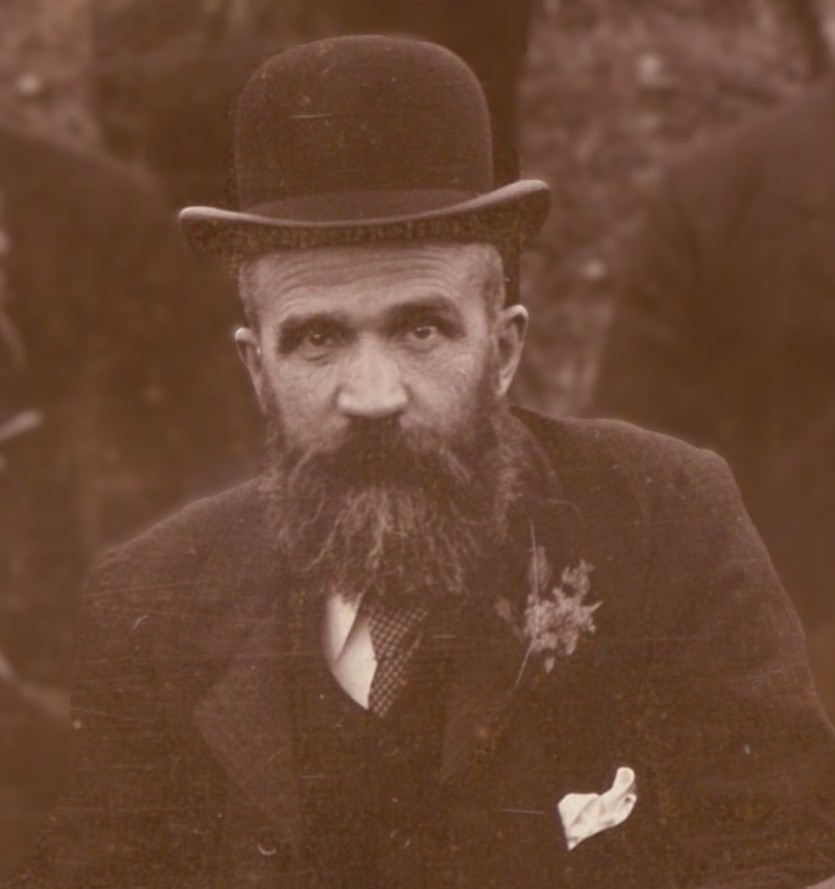
David McMillan – 1906
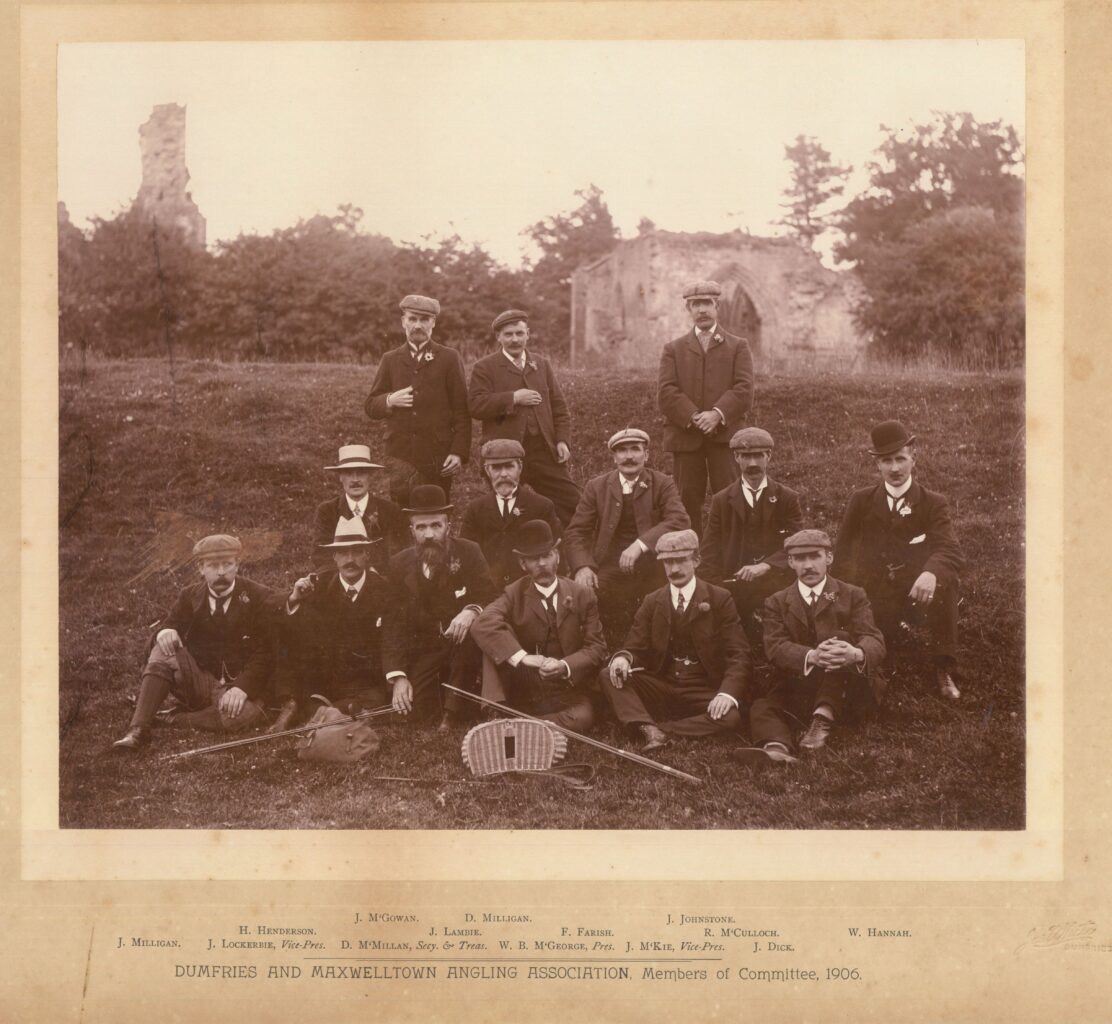
Dumfries & Maxwelltown Angling Association Committee in 1906 at the ruins of Lincluden Abbey, where the River Cairn joins the River Nith
Shaping Angling Policy
The Association has also played a pivotal role in shaping local angling policy. In 1912, following six years of persistent petitioning to successive Secretaries for Scotland — The Rt Hon. John Sinclair and, later, The Rt Hon. Thomas McKinnon Wood — the Association succeeded in having the close of the salmon fishing season on the River Nith extended — from 15th November to 30th November. This landmark victory for local anglers was testament to the Association’s dedication and influence, driven in large part by the tireless efforts of Association Secretary David McMillan. He helped garner 935 signatures from Proprietors, Lessees, Fishing Associations, Town Councils and Anglers backing the proposal with support from the Fishery Board.
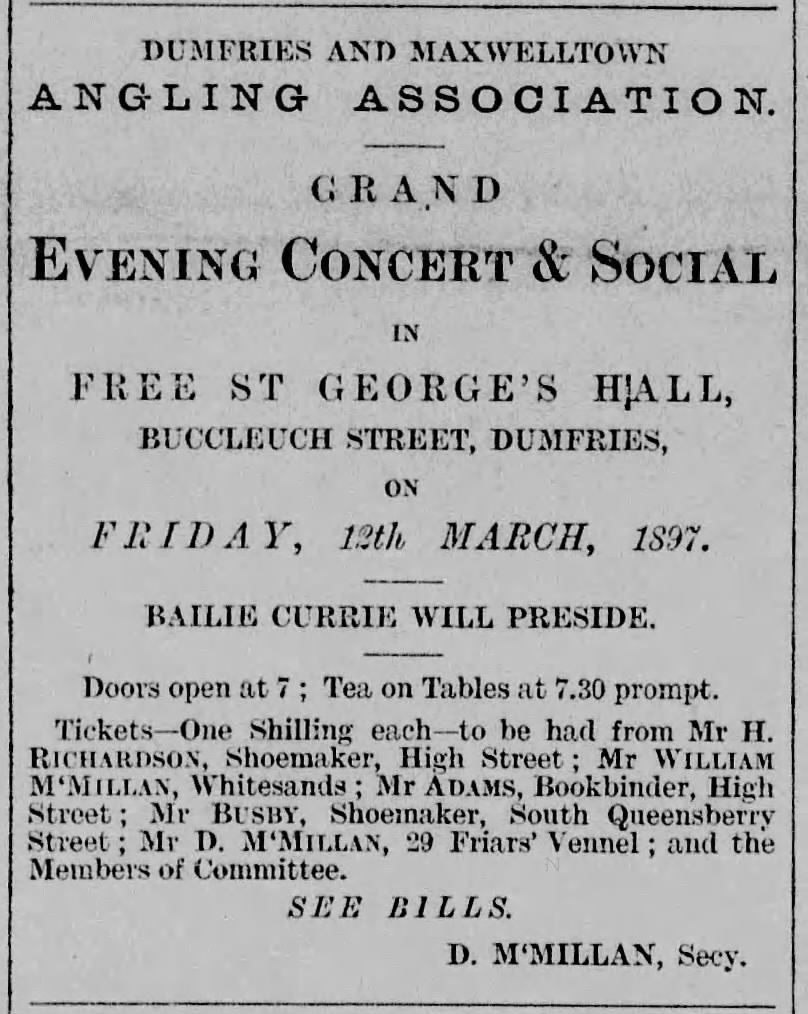
Dumfries & Galloway Standard, 10th March 1897
A Hub for Social and Civic Life
Beyond policy, the Association cultivated a strong sense of community and camaraderie. Social events such as concerts and grand dinners featuring speeches and music became hallmarks of its early years.
Association counted many local officials and respected individuals as members and regular attendees of these concerts and dinners, with one speaker at the 1914 dinner noting there were “quite a number of prominent public gentlemen of Dumfries and Maxwelltown of whom it might be said that they had their finger on the pulse of public affairs”.
In a letter to the Dumfries and Galloway Standard & Advertiser in December 1944, David McMillan (jnr)—son of founding member David McMillan—proudly reflected that the Association “always had numbered among its members many of the most respectable citizens of the burgh, many men who have held the highest public offices in the town”.
These traditions helped shape the Association’s identity, reinforcing its role not only as a steward of local waters but also as a pillar of the community.
Dinner Menus
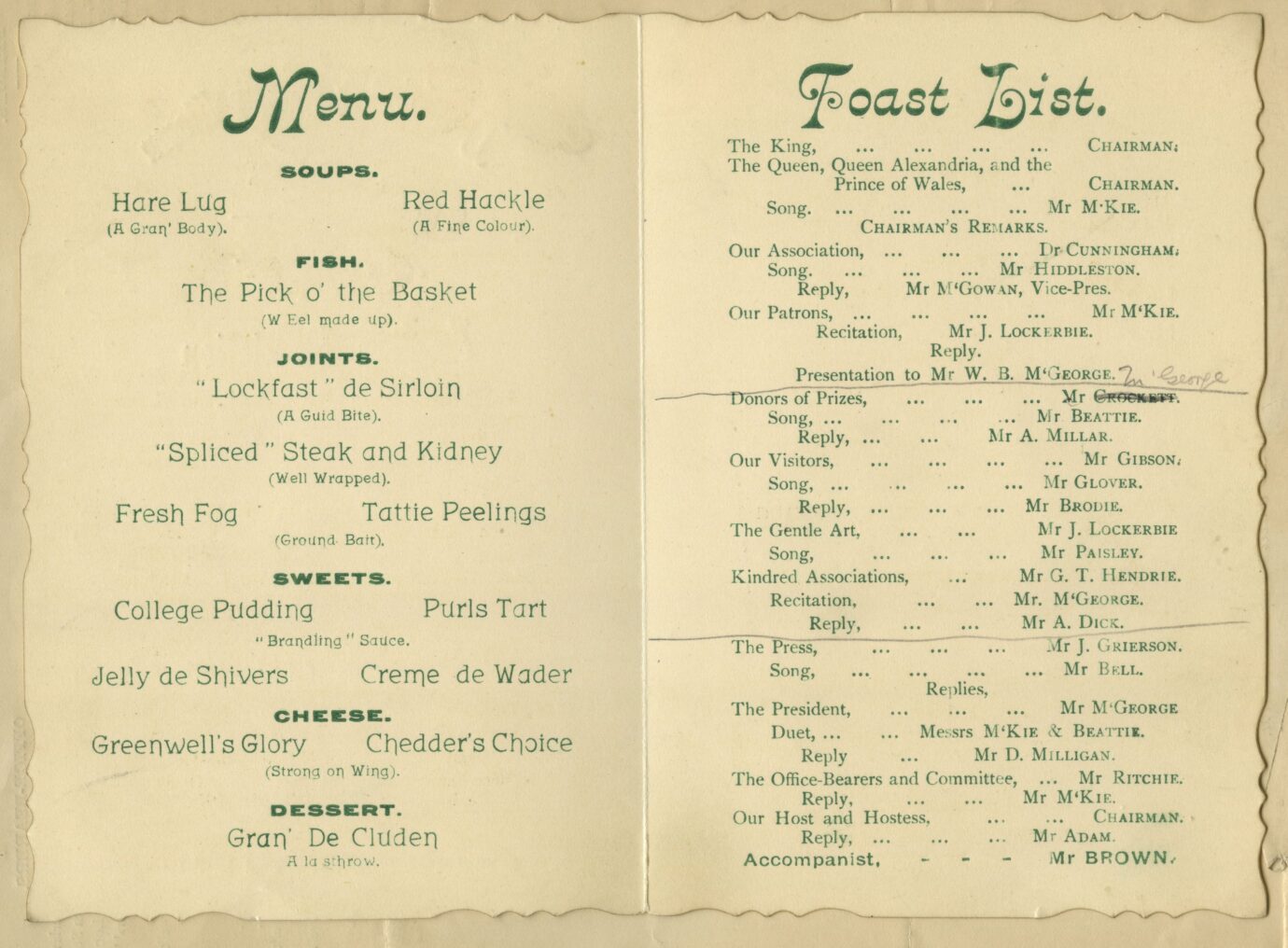
Angling Themed Dinner Menu & Toast List for 1910 Dinner 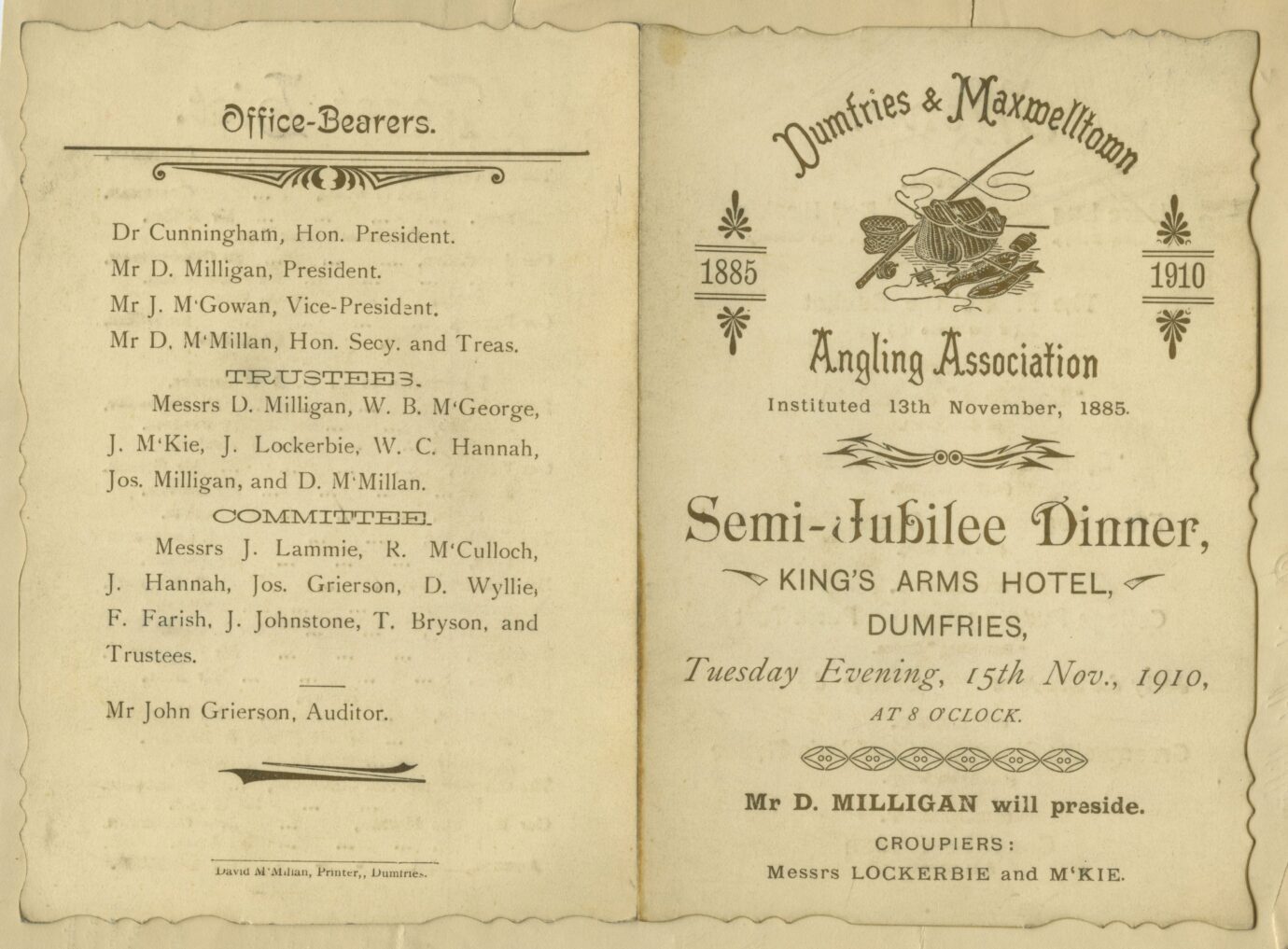
Dinner Card and note of Association Office Bearers, November 1910
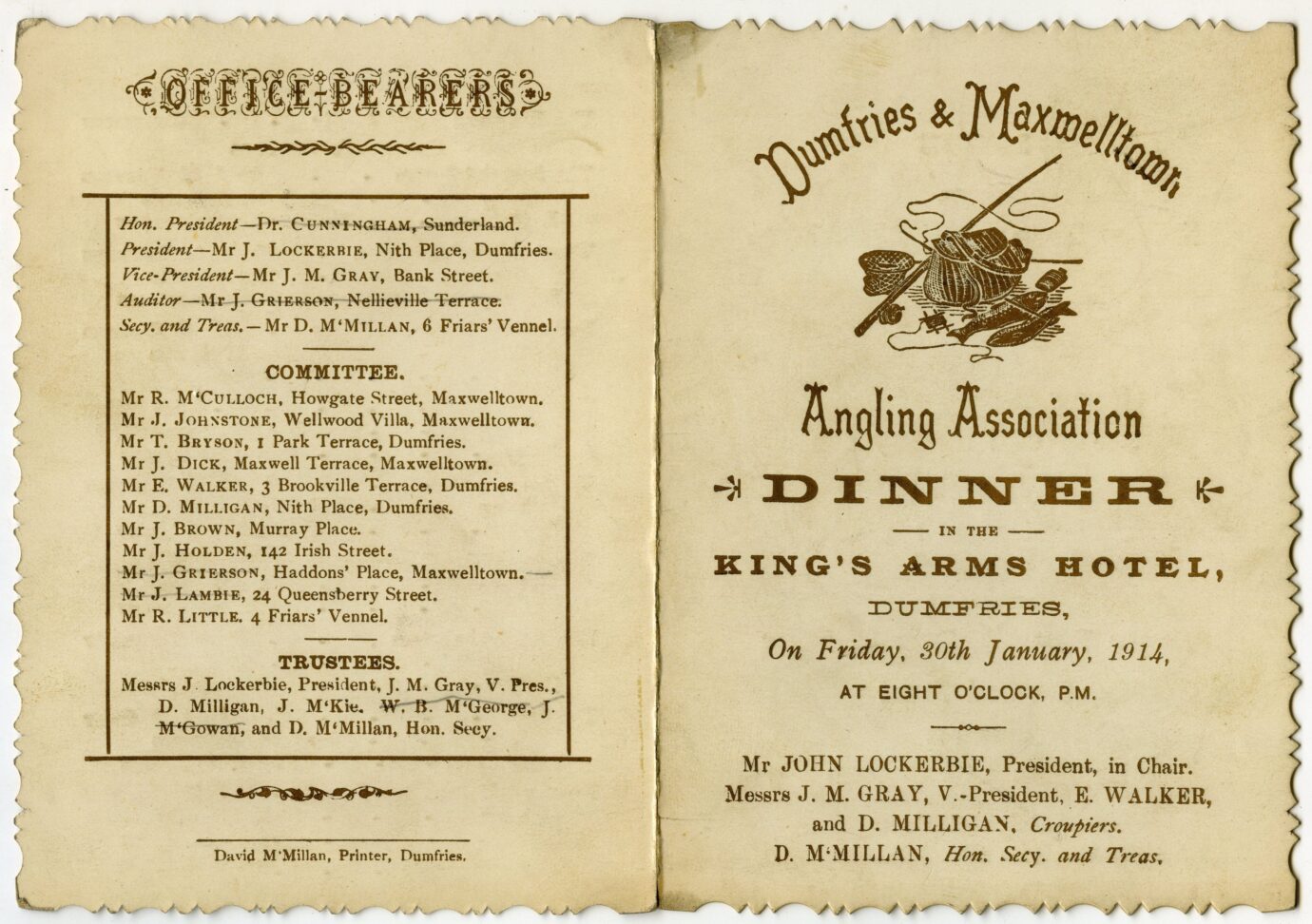
Dinner Card and note of Association Office Bearers, January 1914 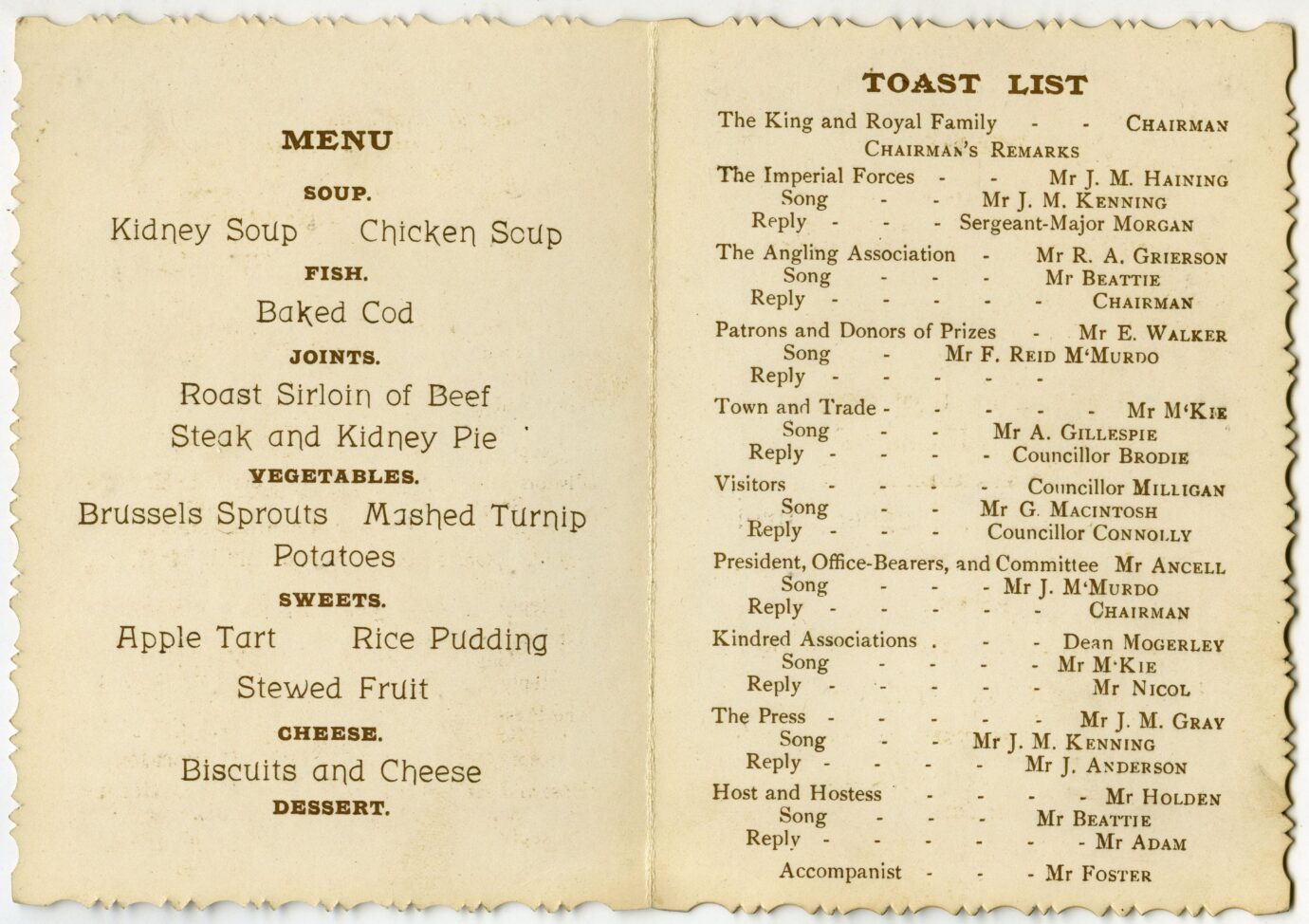
Menu and Toast List for January 1914 Dinner
The 1925 Merger
In 1925, the Association entered a new chapter when it merged with the Dumfries & Galloway Angling Promotion and Protection Club which had been independently established in 1888. Following the merger, the unified organisation adopted the name of the Dumfries and Galloway Angling Association (DGAA), a name which it still proudly carries today over a century later.
This 1925 amalgamation strengthened the Association’s role in promoting and protecting angling across the River Nith and River Cairn, laying the foundation for its enduring presence in the region.
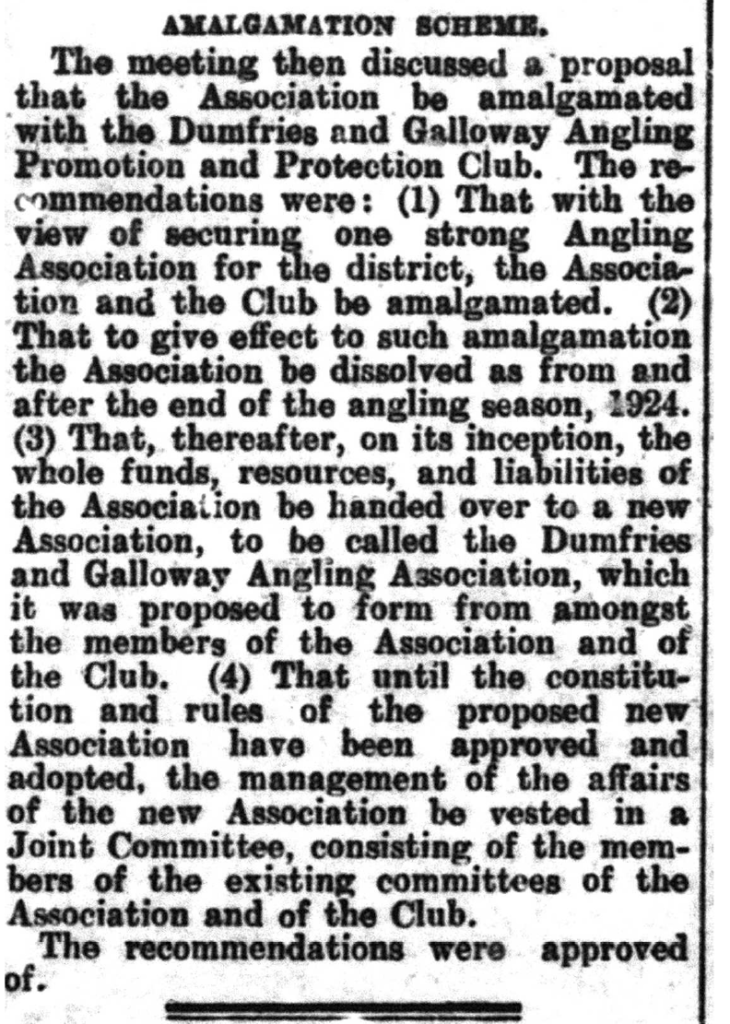
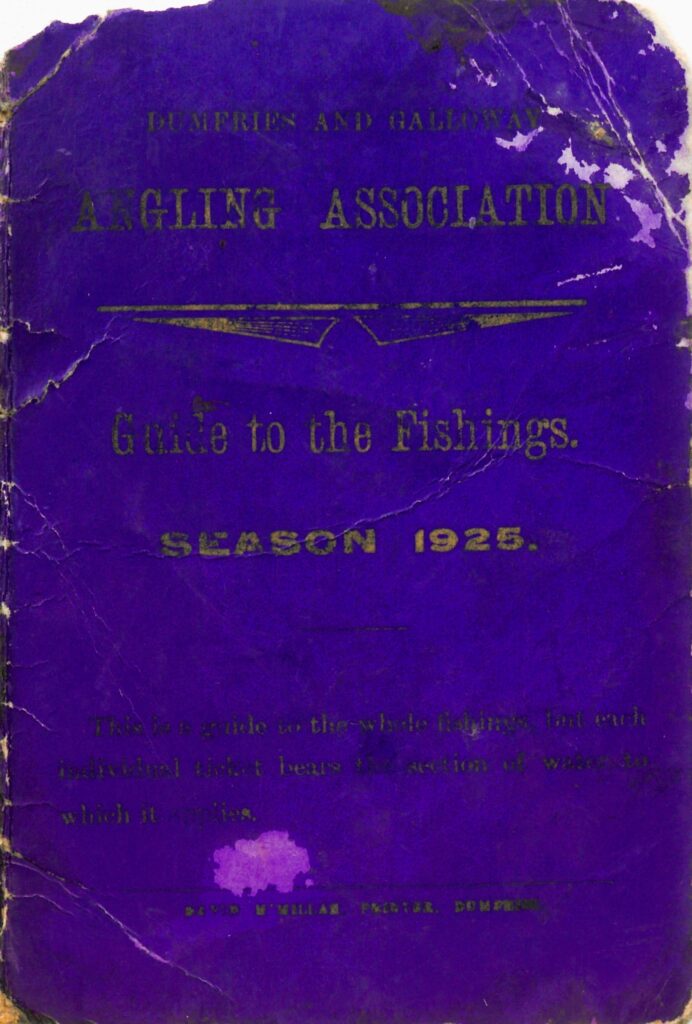
An interesting footnote in local angling history is the existence of a separate club —also named the Dumfries & Galloway Angling Association—which was briefly active from 1896. This earlier organisation mostly managed fishing on the Lotus Loch (now Loch Arthur) and small parts of the River Cairn. However, it ceased to exist in the early 1900s and bears no connection to the present-day Association.
Traditions and Competitions
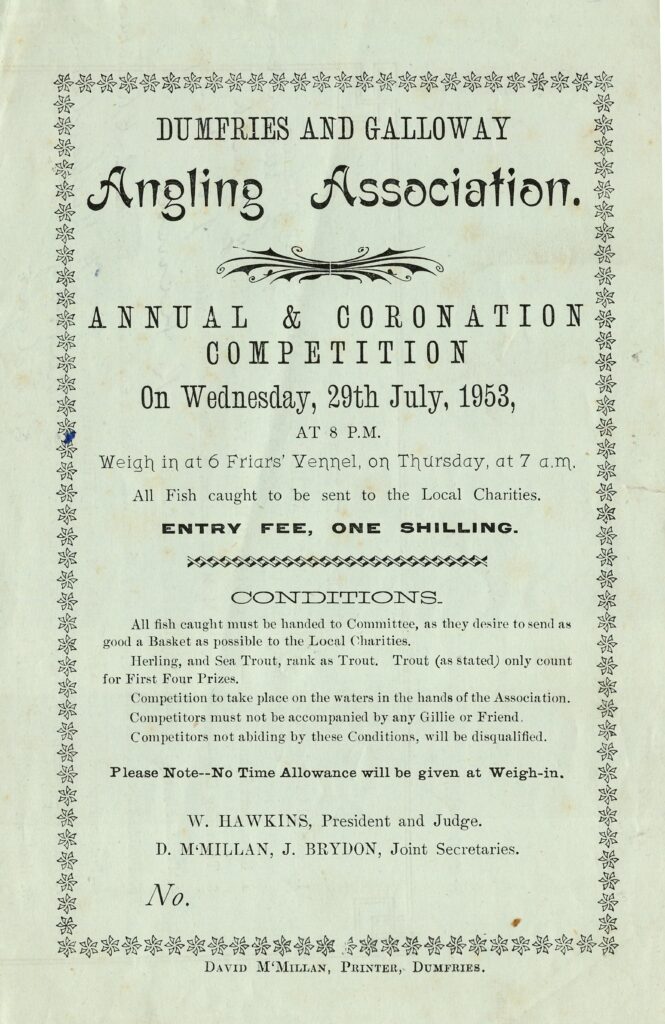
As far back as 1897, the Association held an annual competition, and from 1915 onwards this was typically held in July, running from 8pm to 7am. The event offered a variety of prizes and drew enthusiastic participation from members, traditionally with an ‘adjournment’ for a midnight supper accompanied with songs and merriment at a central location, before fishing then resumed. This annual event went ahead irrespective of the weather, although some of the reports record some fairly adverse conditions!
During World War II the event was postponed — although fishing did continue and the Committee granted permits to returning soldiers — and cancelled again in 1952 due to the outbreak of Foot & Mouth disease, when all fishings were closed.
Following the competition, anglers would gather at McMillans Tackle at 6 Friars Vennel in the morning, where the catch was weighed and recorded in the Competition Book (which began in 1926 and still survives to this day), and a grand list of prizes awarded. The fish were then all donated to various local charities and hospital kitchens.
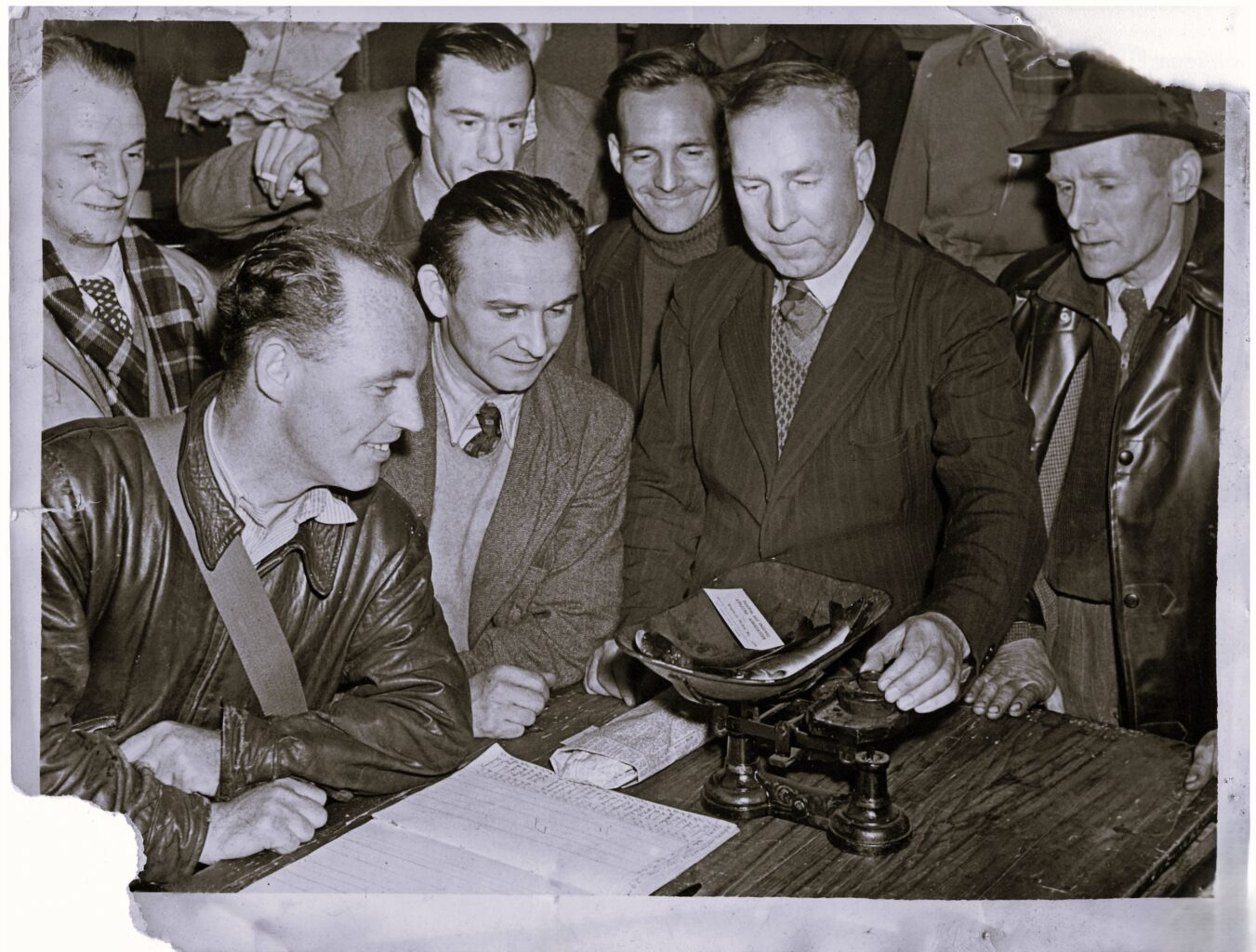
David McMillan conducting the competition weigh-in the morning of 30th July 1953
Watching on are (L-R back row) Willie Chambers, Jock Richardson & Sam McMillan and leaning on table to David’s right, Bertie Chambers. The pages in the book recording the weights can be seen in the picture shown below
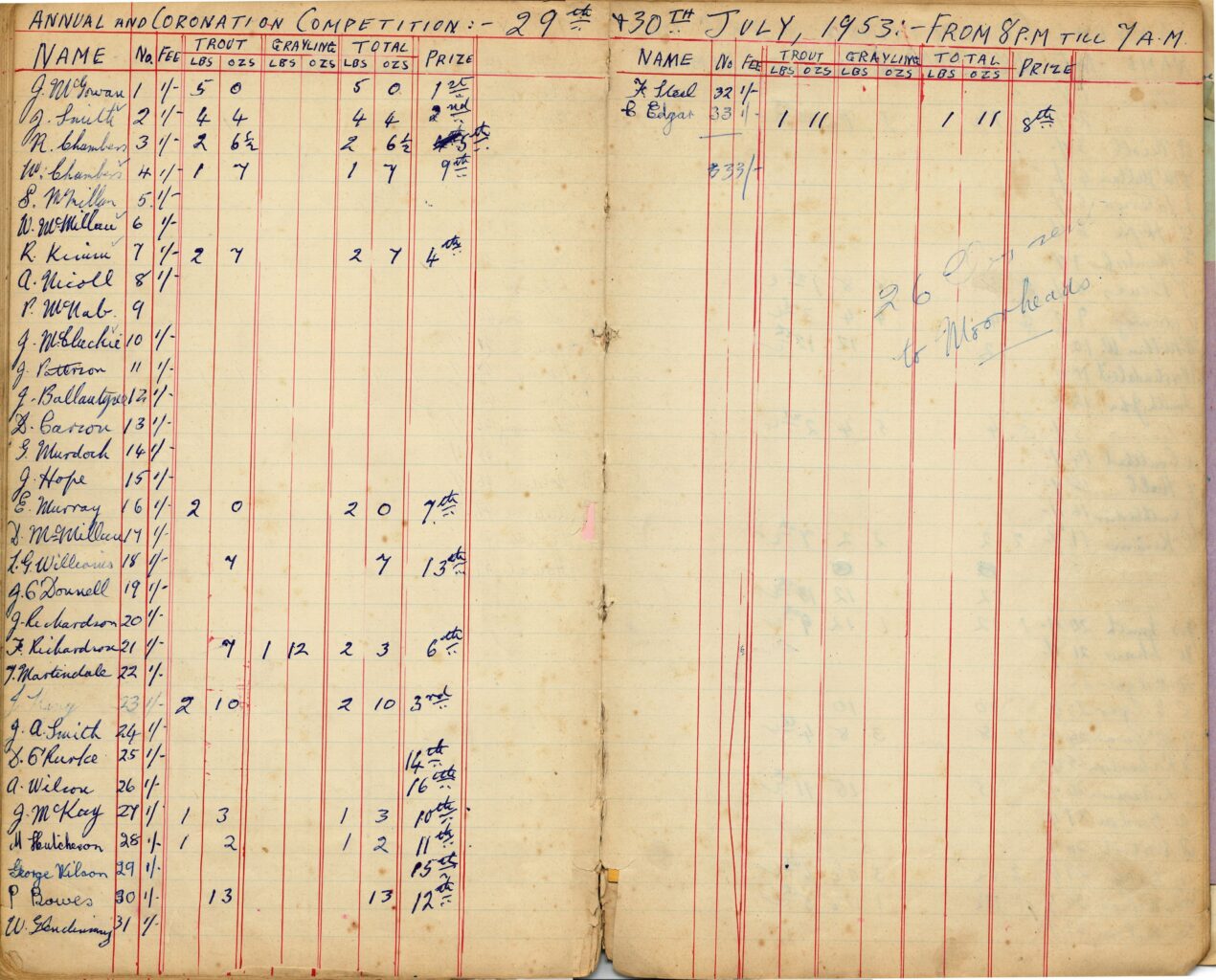
1953 Annual and Coronation Competition Results Page showing 33 competitors who took part
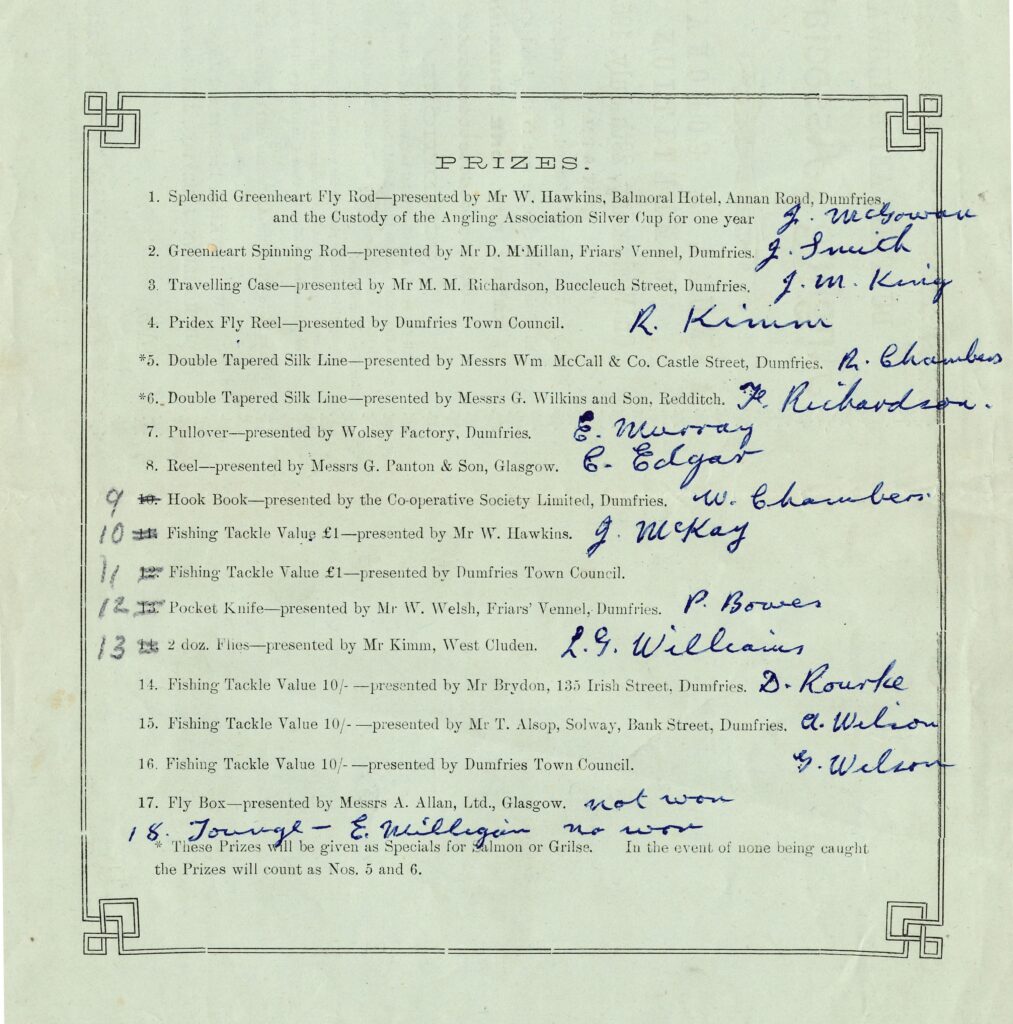
1953 Competition Prize List and winners noted
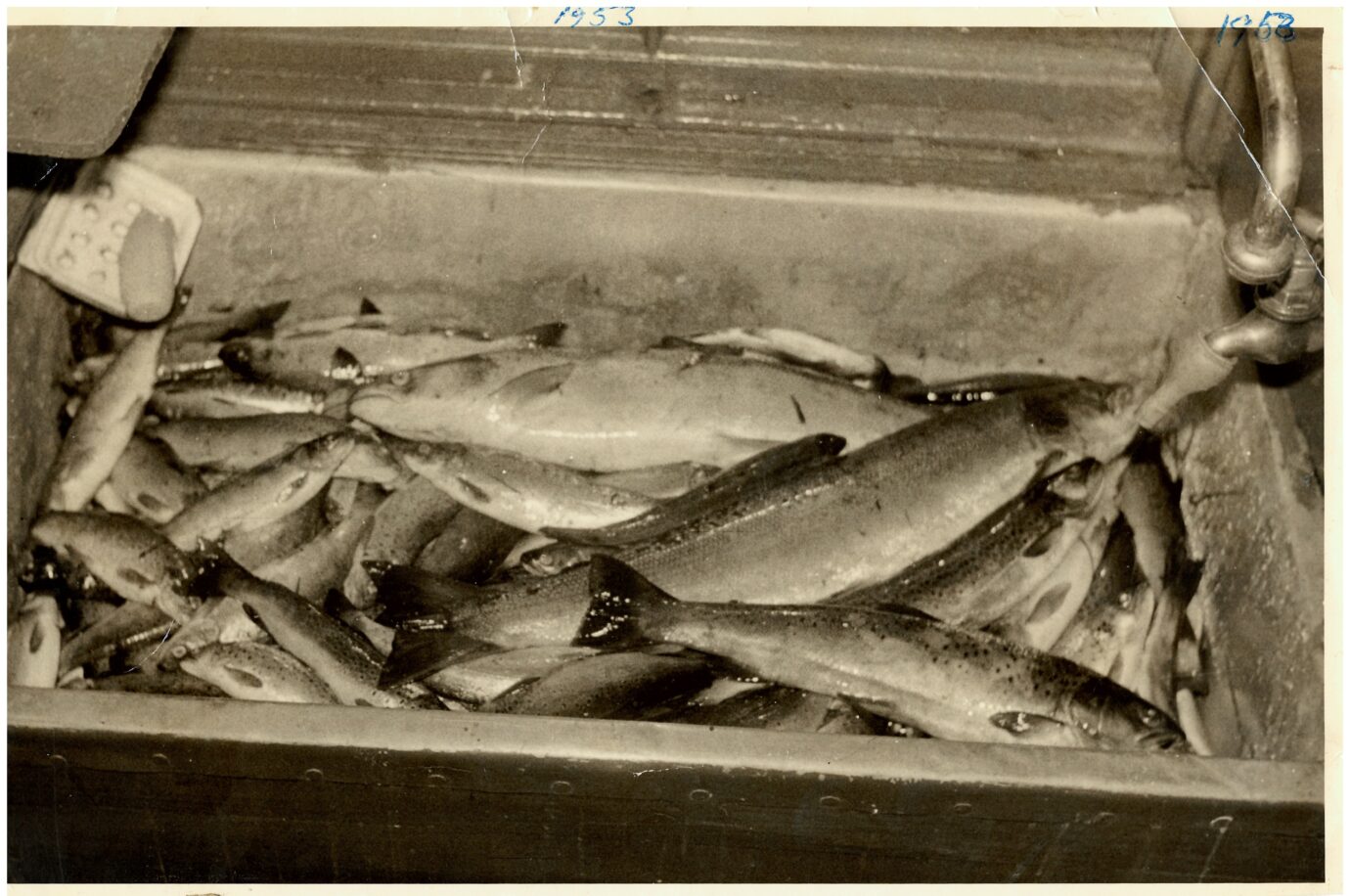
The 1953 competition catch, all donated to various local charities and hospital kitchens
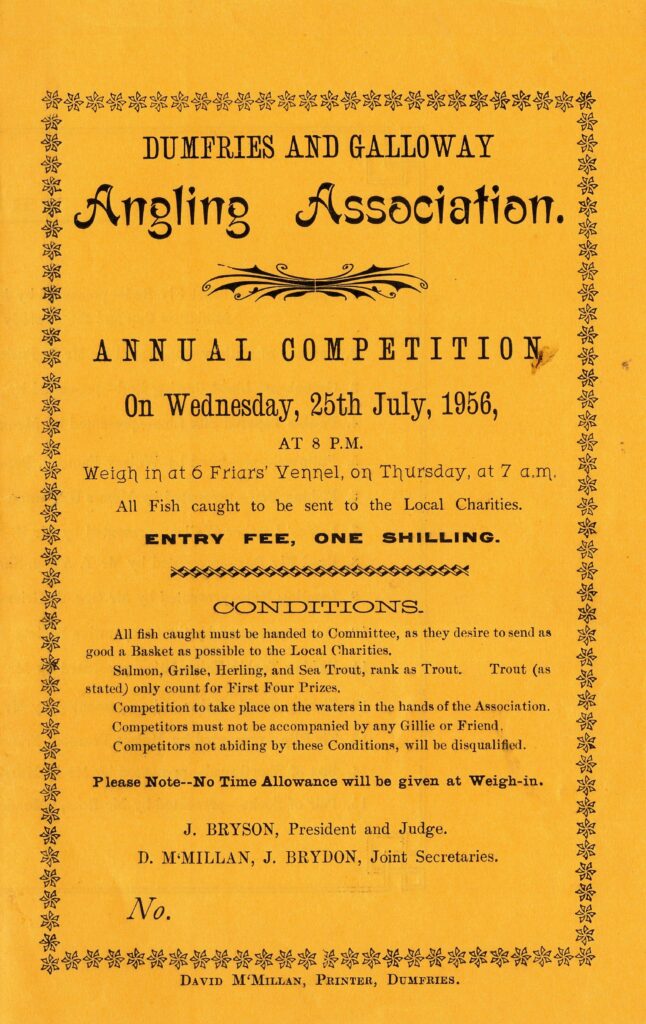
Flyer for July 1956 Competition
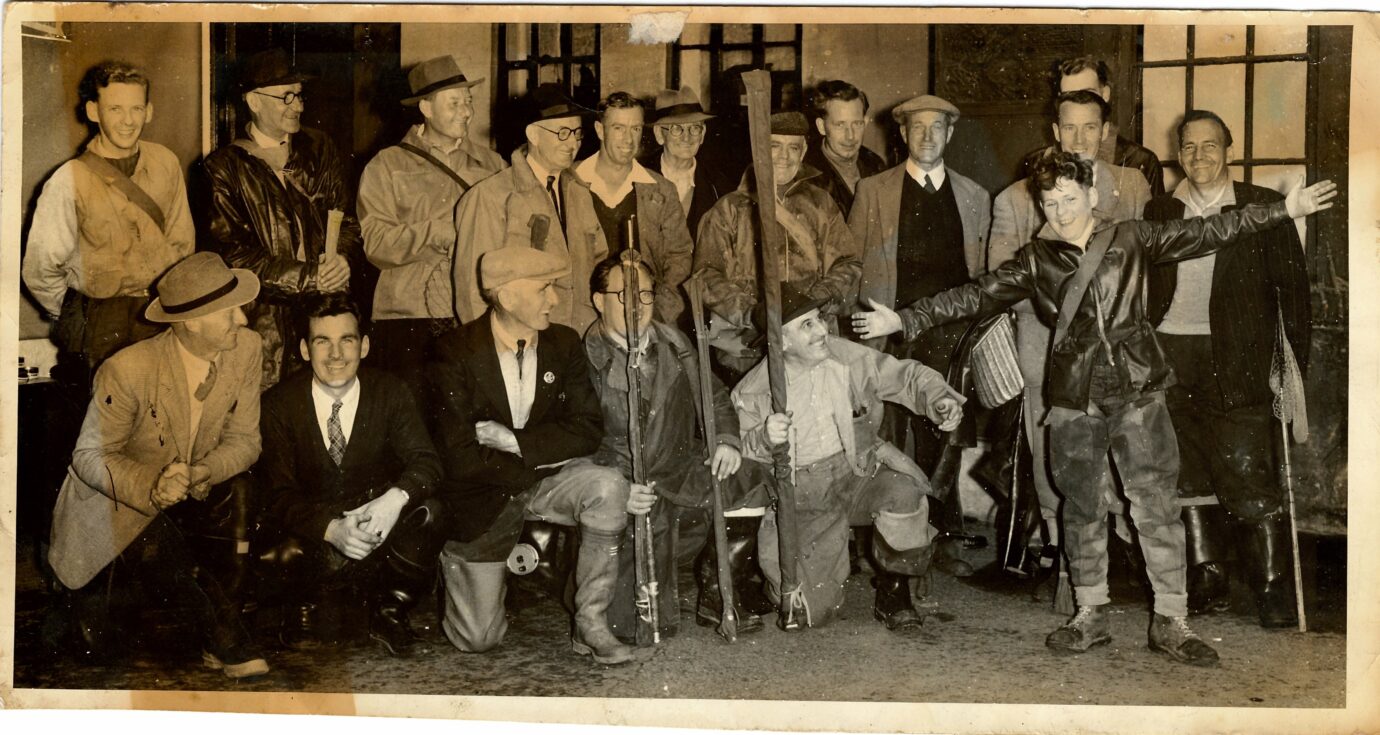
Anglers before the July 1956 competition
Front Row: W. McCormick, W.G. McMillan, J. Martin, S. Wells, T. Alsop, C. Rourke
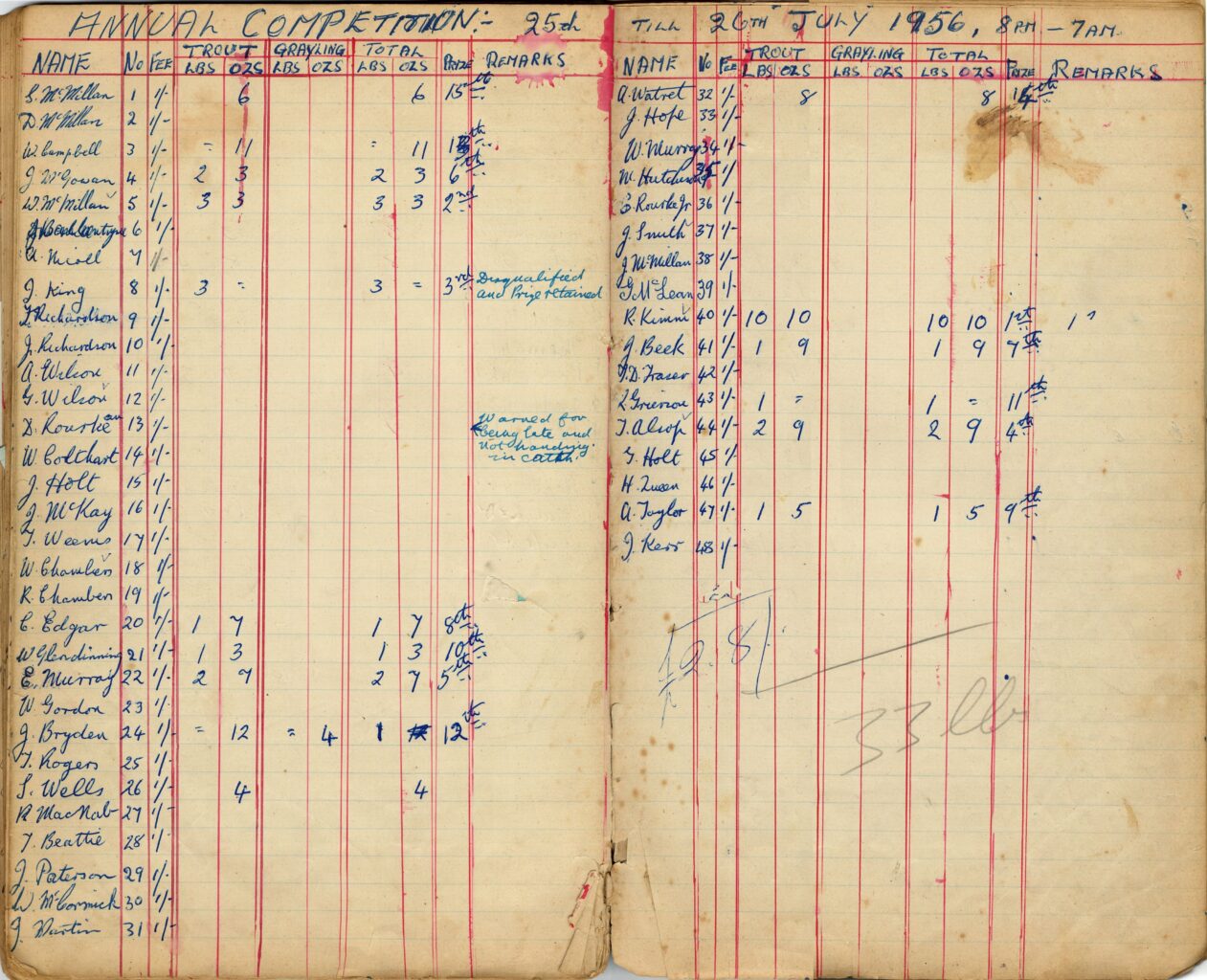
1956 Competition Results pages, showing an impressive 33lbs caught between 48 entrants
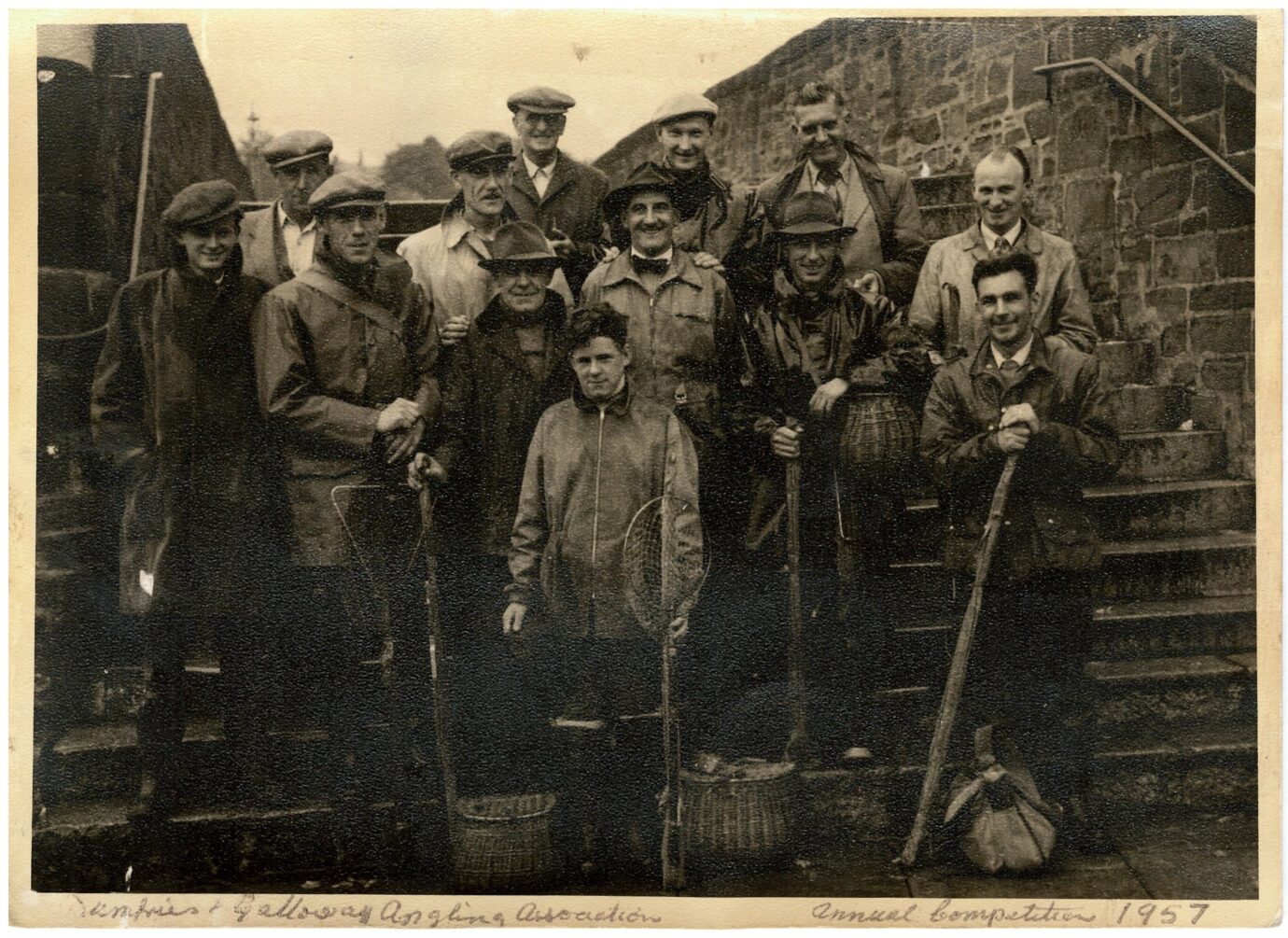
Anglers ahead of July 1957 competition, standing at the steps of the Devorgilla Bridge, White Sands, Dumfries
Middle Row – G. Wilson, D. Chalmers, D. Rourke, T. Alsop, M. Carrick, W.G. McMillan
Front Row – C. Rourke
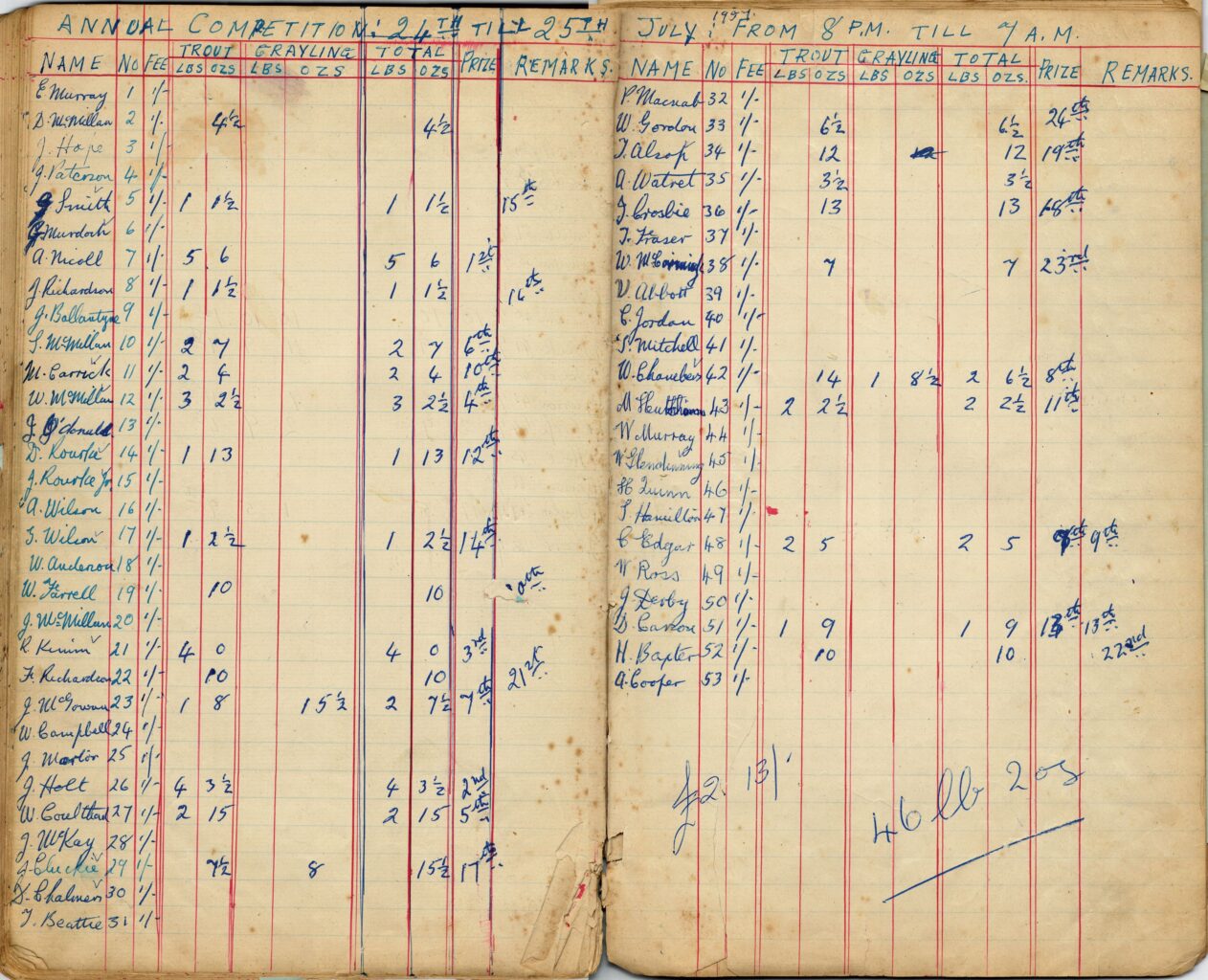
1957 Competition Results page with a huge 46lb 2oz of fish caught between 53 entrants
Fewings Trophy
Among the traditions that have developed over the years is the awarding of the Fewings Trophy. This trophy is not only a celebration of skill but also a nod to the tradition of fly fishing on the River Nith. First presented in 1973 for the largest fly caught brown trout, the trophy was named in honour of W.R Fewing, long-standing member and beneficent angler. In 1988 the Committee resolved to change the trophy award, presenting it annually for the largest fly-caught salmon of the season.
Over the years the trophy has been claimed by seasoned veterans and rising talents alike, each recipient earning their place in the Association’s legacy, their name proudly engraved upon it. Presented at the February AGM, it is an honour to be awarded and is proudly retained within the angler’s home, as long as they are the holder, so for a season at least!
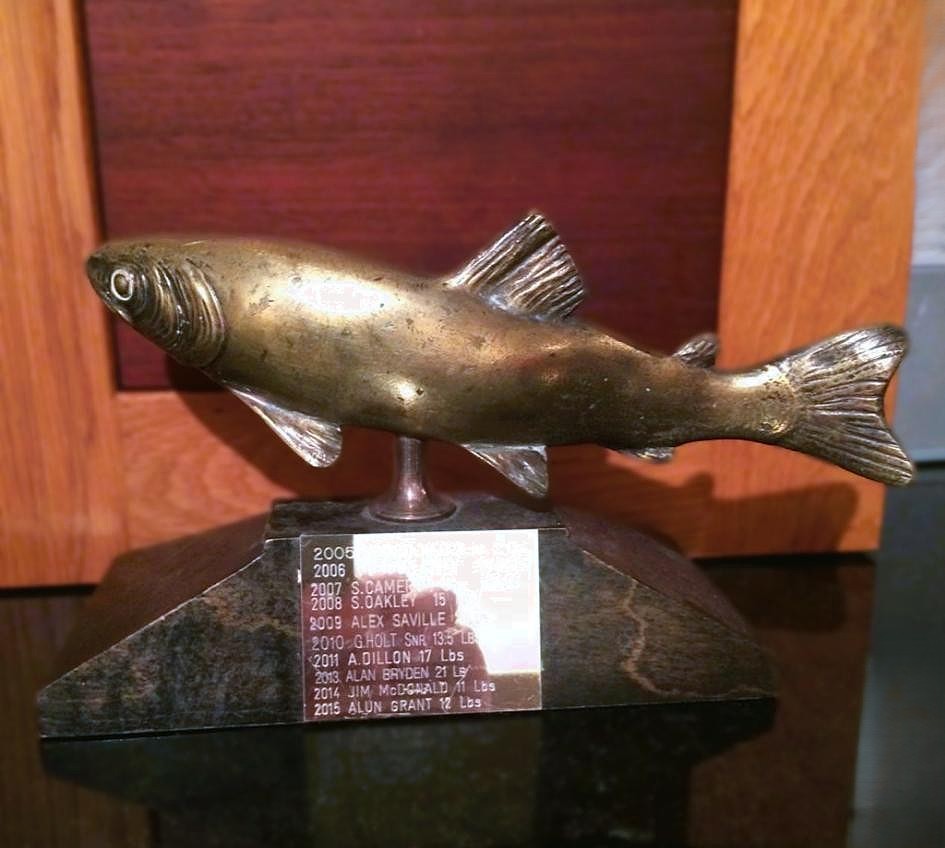
The Fewings Trophy
Association Fishings
Over the decades, the Association has experienced fluctuations in the waters it fishes, with leased areas on both the River Nith and one of its principal tributaries the River Cairn, coming and going. One of its most significant achievements was the fortunate opportunity to acquire the fishing rights on the River Nith at Carnsalloch in the 1950s —an asset it continues to own to this day. This long-term ownership has provided the Association with a foundation of stability and stewardship of these waters which remain cherished by its members.
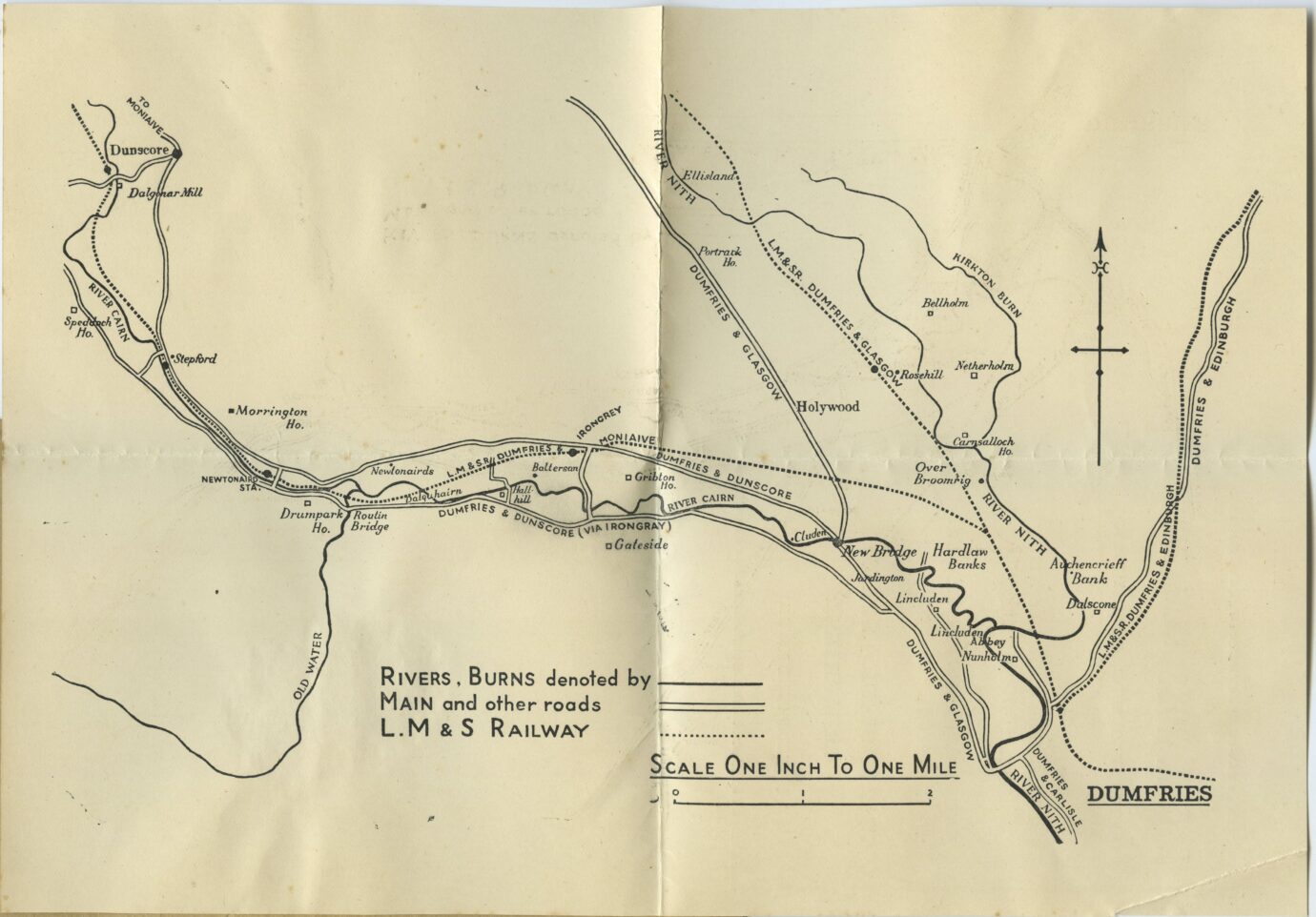
Map of the Rivers Cairn and Nith from Rule Booklet, 1938. Much of the River Cairn could be conveniently accessed by rail via the Cairn Valley Light Railway to Moniaive, with stations at various points along the river, until the line closed in 1943
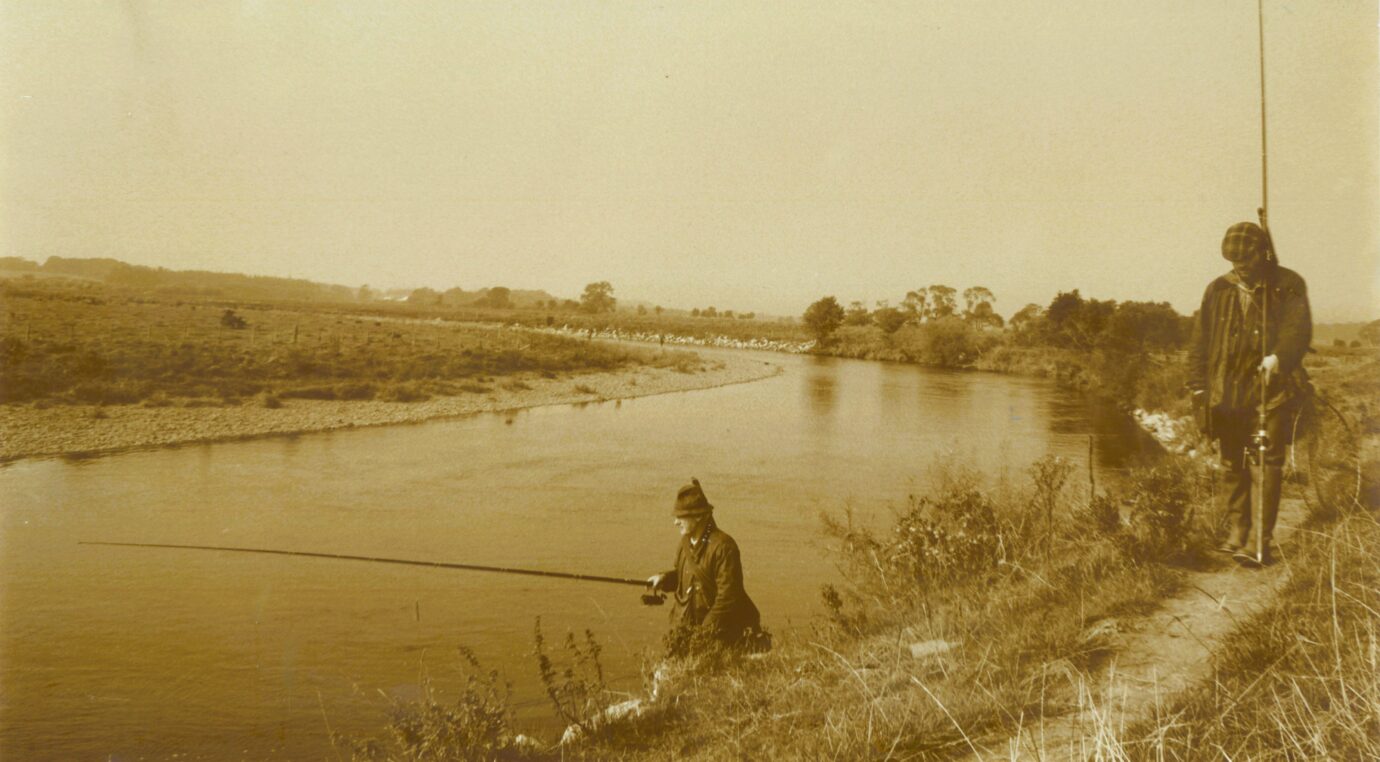
The ‘Stab Pool’ below Carnsalloch on the River Nith with Willie Howat fishing and unknown angler walking on the top of the bank, 1971.
Salmon Catches
One of the most significant challenges faced by the River Nith was the outbreak of Ulcerative Dermal Necrosis (UDN), a disease which first appeared in Autumn 1966 and devastated migratory fish populations in 1967. Fishery Board records from the time document a dramatic decline (over 50%) in returning salmon and sea trout, deeply affecting both the river ecosystem and the angling community. A particularly stark entry in the Fishery Board Records notes:
“UDN rampant throughout season and reached frightening proportions in October. Banks of the Nith a graveyard”
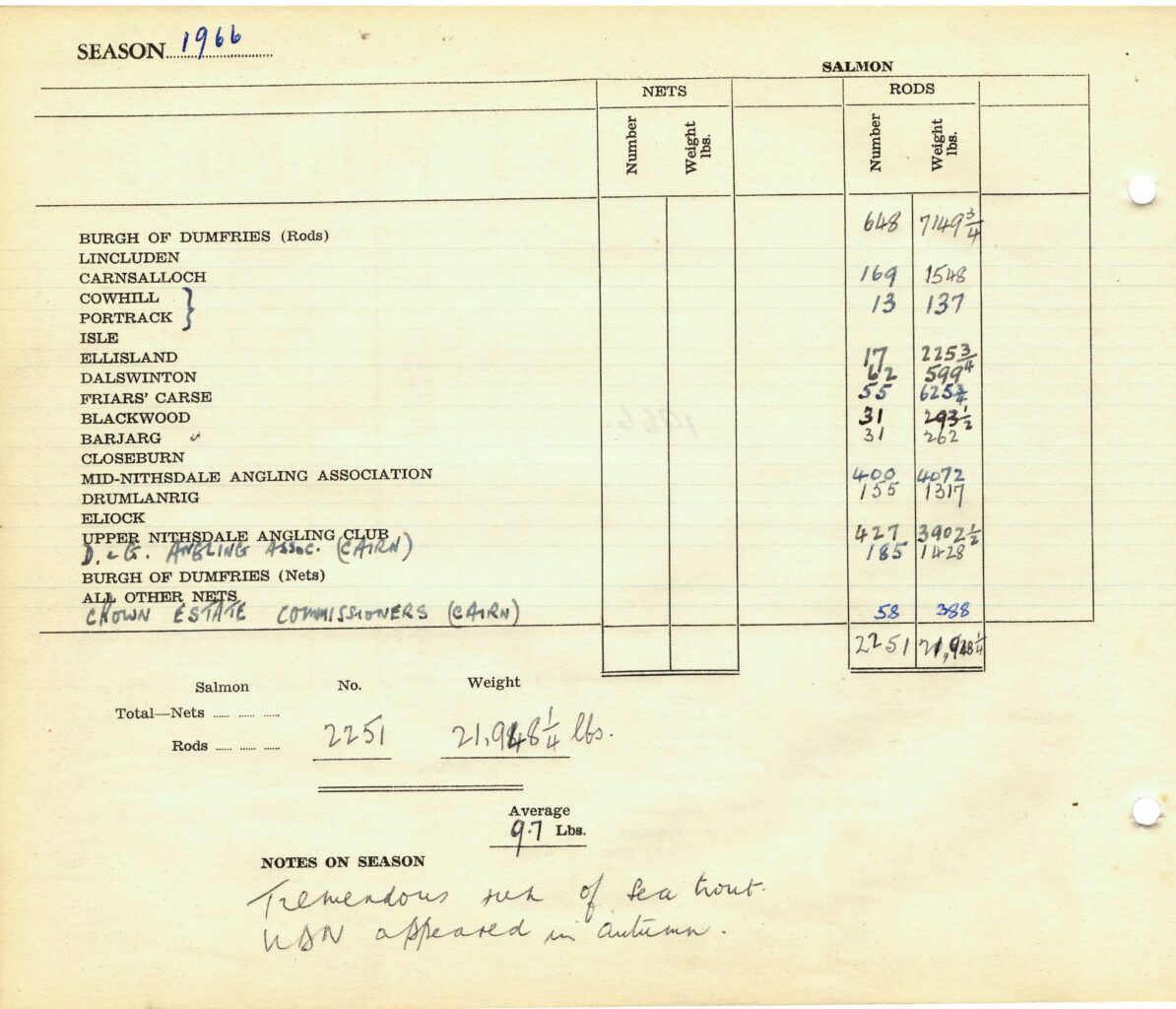
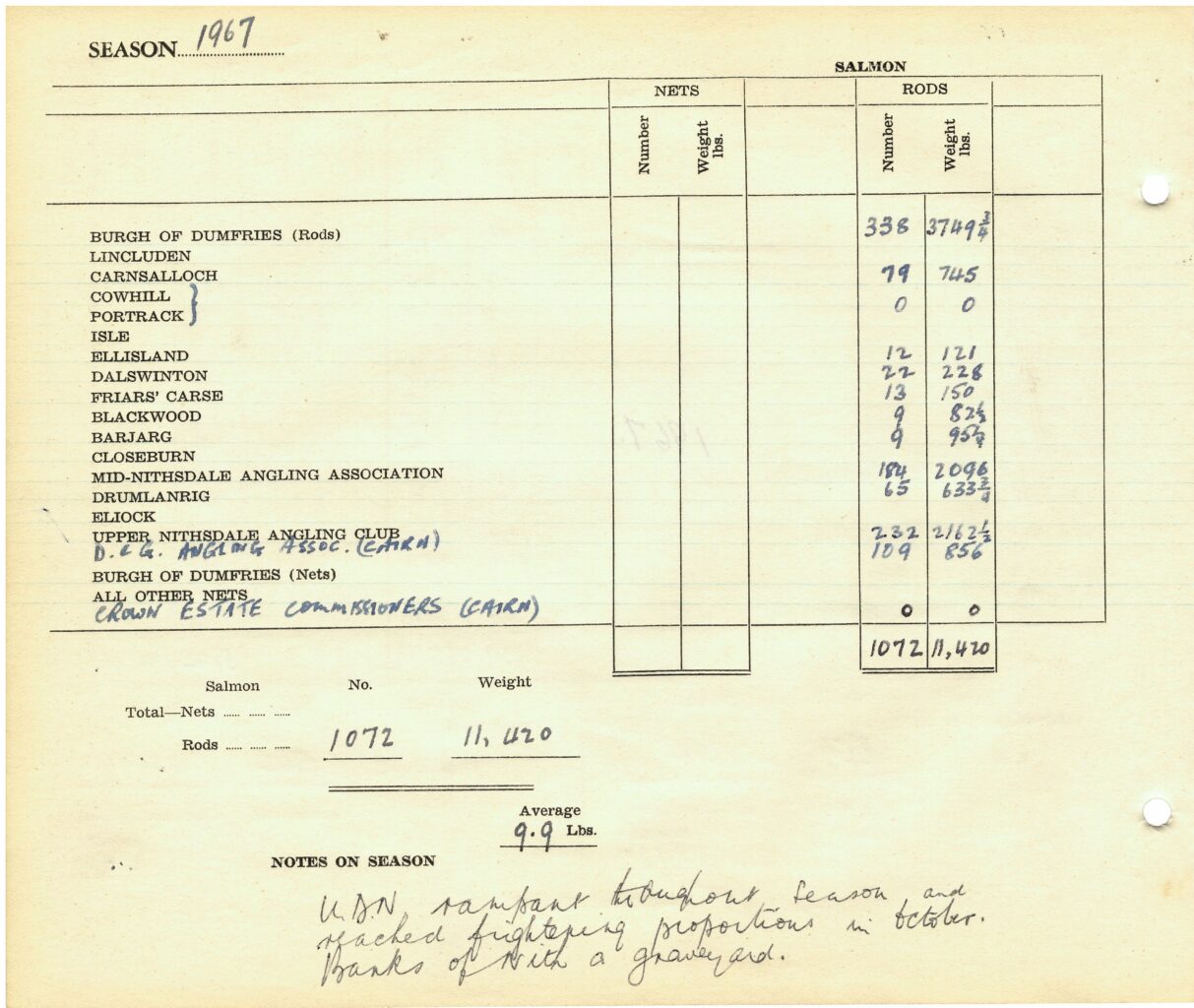
Over the past half century, wild Atlantic salmon and sea trout numbers in Scotland have declined significantly, particularly since the 1970s. Once abundant, their populations have been impacted by habitat loss, disease (such as UDN), overfishing, pollution, and climate change. Despite conservation efforts like catch-and-release and the end of coastal netting, many rivers—including the Nith—continue to see reduced spawning returns. We are hopeful that the Scottish Government’s Wild Salmon Strategy will make a meaningful impact at a national level and help reverse these declines, working in close collaboration at a local level with the Nith Catchment Fishery Trust, the Nith District Salmon Fishery Board and the owners and proprietors of the fishings.
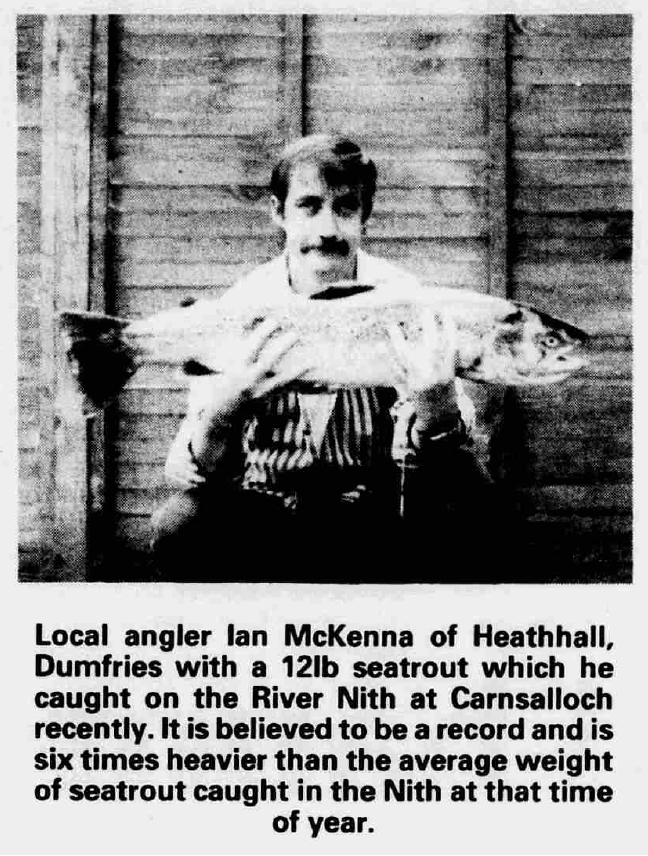
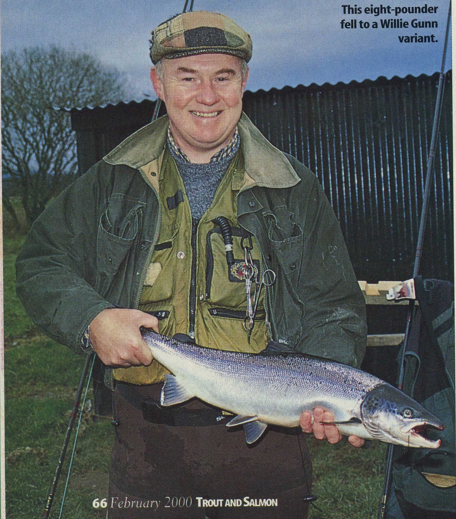
Despite the difficulties, some seasons sit apart from others. The 1988 Nith season lives long in the memory for many anglers; recording the highest number of rod-caught salmon & grilse on record, 4,062 salmon, 1,629 grilse alongside 4,591 sea trout. Of these, the DGAA beats accounted for 645 salmon, 519 grilse, and 559 sea trout.
Membership
Membership within the Association was once divided into distinct categories: Full Members, Juveniles, and School Boys. The fishing waters themselves were organised into sections—Whole, Lower, Middle, and Upper. At its peak, total membership numbered up to 450, with a long waiting list of over a decade.
In many cases Juvenile and school boys joined the Association at a young age and, provided they had earned sufficient continuous years membership, when they reached 18 would be awarded an adult (Full Member) ticket and not have to join the lengthy waiting list. This system not only encouraged early engagement with angling but also fostered long-term loyalty and continuity within the Association.
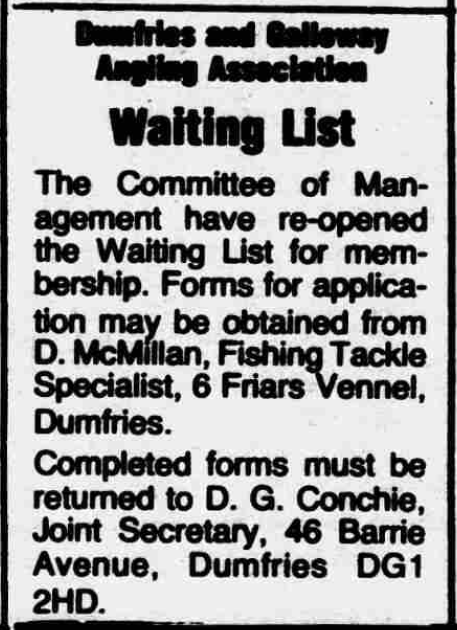
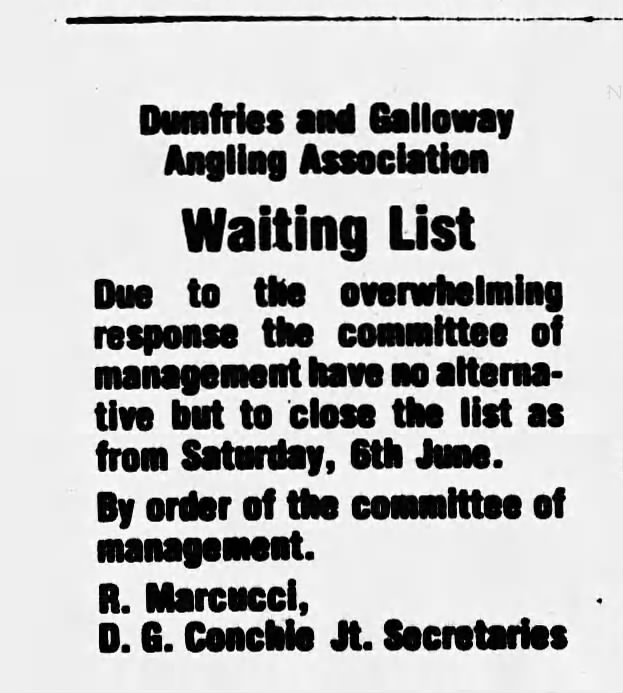
Today, while membership numbers have declined from their historic highs, the DGAA strives to continue to uphold its founding values. The decrease reflects broader national trends with reduction in salmon stocks and a general drop in interest in angling as a pastime. Despite these challenges, the DGAA aims to remain a cornerstone of the local angling community—committed to conservation, tradition, and the shared joy of fishing in the scenic waters of the River Nith and the River Cairn.
The Association actively supports the next generation of anglers as it regularly hosts the Nith Young Anglers. This initiative, run by the Nith Catchment Fishery Trust gives young people the opportunity to learn a variety of fishing techniques for salmon, trout and grayling (as well as coarse fish at other venues) through free, professionally guided sessions, aiming to foster a lifelong appreciation for angling and river stewardship.
Members also continue to play a hands-on role in maintenance of the river. Volunteer work parties carry out essential maintenance along the beats on the River Nith and River Cairn including strimming overgrown paths, clearing debris, repairing stiles and signage, and managing invasive species. These efforts ensure that the riverbanks remain accessible, safe, and appealing for both members and visiting anglers alike — ensuring that the beat remains a source of pride and enjoyment now and for generations to come.
2025 Season Opening
In celebrating its centenary year, the 2025 salmon fishing season on the River Nith was officially opened on 25th February 2025 with a ceremony held at Carnsalloch, organised by the Nith District Salmon Fishery Board in collaboration with the DGAA.
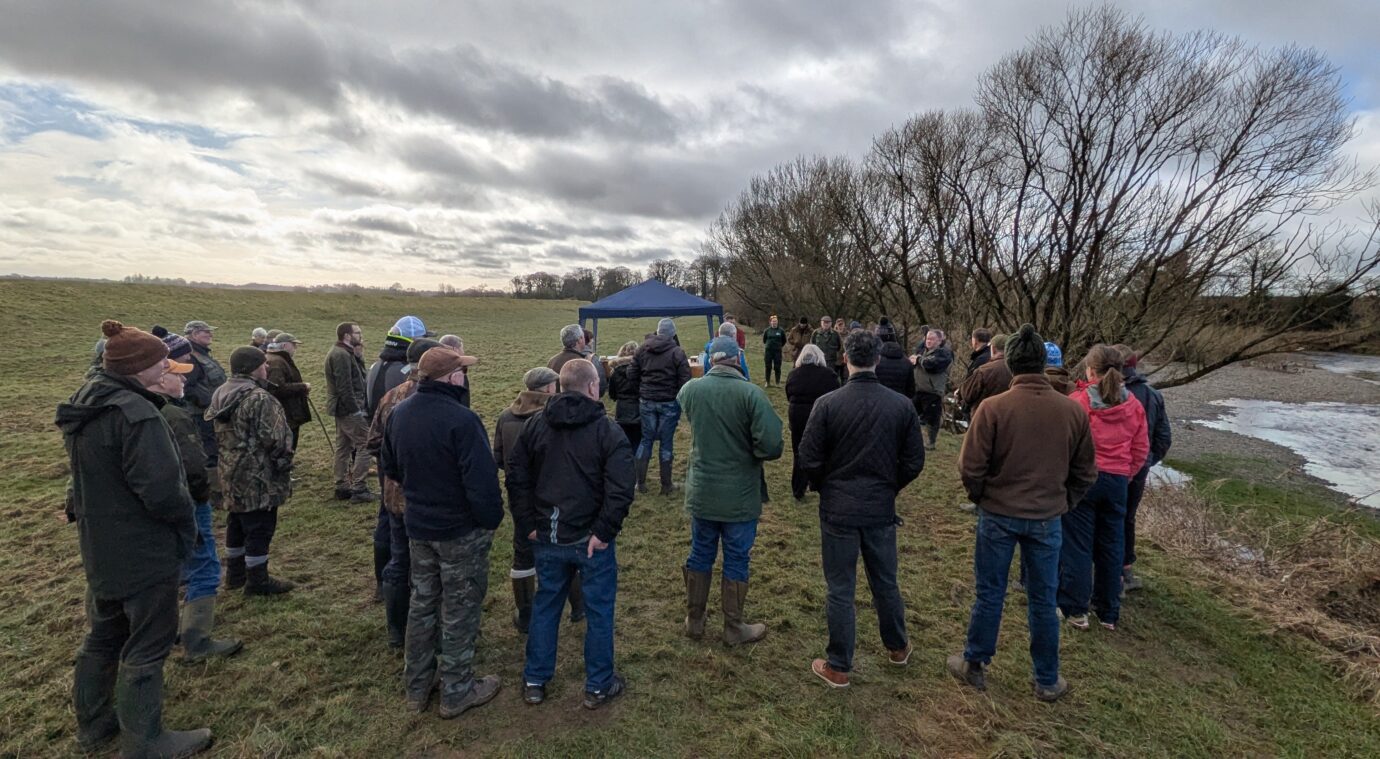
A good crowd attended the opening ceremony at Carnsalloch on 25th February 2025
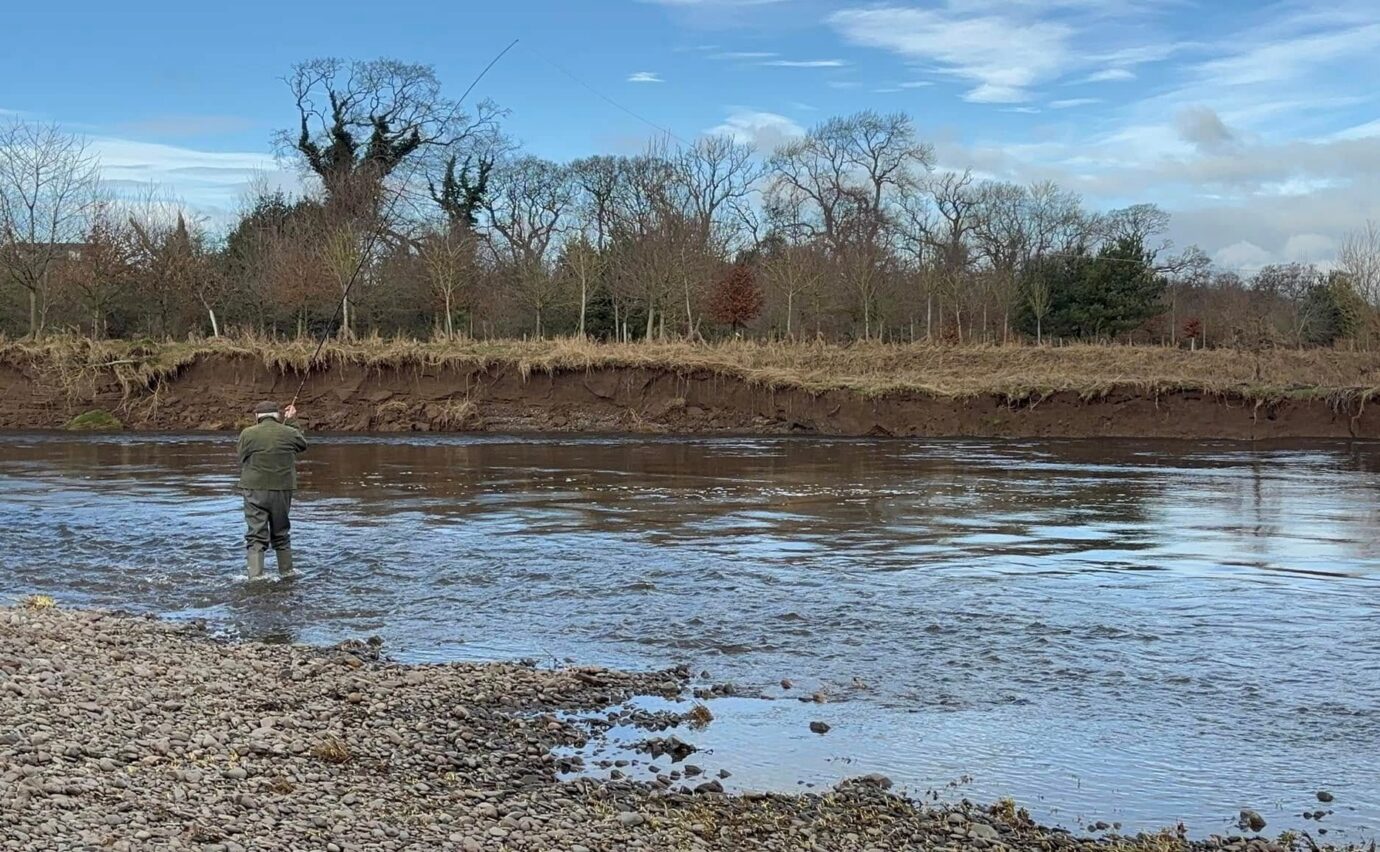
Long-time DGAA Member, Raymond Mundle makes the all-important ‘first cast’ at the tail of the Stab Pool, officially opening the season.
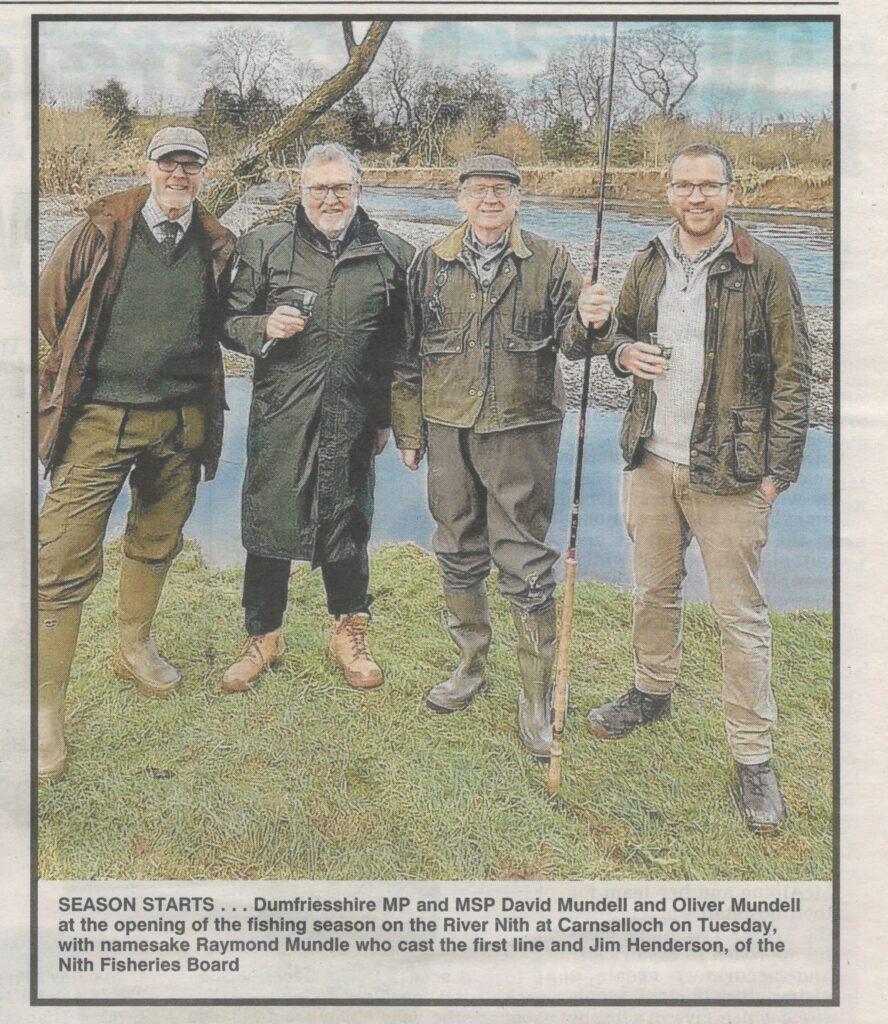
Extract from the Dumfries Courier 27th February 2025
Concluding Remarks
As the Dumfries and Galloway Angling Association marks its centenary, it stands as a testament to over a hundred years of stewardship, tradition and community spirit. Since its original formation as the Dumfries & Maxwelltown Angling Association in the Victorian era, the Association has remained committed to its founding values working to preserve the angling on the river it serves.
While challenges such as declining fish stocks and shifting public interest persist, the Association continues to work in honouring the legacy of generations who have cast their lines in its waters. It actively promotes the river, seeks to grow its membership, and strives to improve angling now and for the future — endeavouring to inspire new generations of river stewards along the way.
With its rich history, dedicated membership and ongoing support for young anglers, the DGAA continues to cast a hopeful line into the future of its beloved river. As the Town Clerk noted at the Association’s 1914 dinner: “While there were more majestic rivers, there were none with more beauty and charm than our own native stream.”